Vendors love to advertise 97 to 99% accuracy. Then Scribbr ran the same tools through a standardized corpus and the numbers cratered: Originality.ai landed at 76%, Copyleaks at 66%, and GPTZero at just 52%. That gap is why I built this roundup around independent benchmarks instead of marketing pages.
To find the best AI detector for essays, I ranked 8 tools on third-party data (Scribbr’s 12-tool test, the RAID benchmark, Stanford’s TOEFL study, and Chicago Booth’s false-positive research) plus the thing most reviews skip: fairness. Each tool gets a “best for” tag so students checking their own work and educators screening submissions can both find their pick.
One framing to set up front, because it shapes everything below. A detector score is a likelihood signal, not proof of cheating. The stakes are real: a Georgia student lost her HOPE scholarship over a single Grammarly-triggered flag, and 12+ universities have switched Turnitin’s detector off entirely.
An at-a-glance comparison table comes first, then a short how-it-works explainer, then the 9 reviews and my verdict.
How AI Detectors Actually Work: Perplexity, Burstiness, and Why Watermarking Failed
| Tool | Best for | Free tier | Starting price | Independent accuracy | ESL false-positive note |
|---|---|---|---|---|---|
| GPTZero | Educators & students | 10,000 words/mo | $14.99/mo | RAID 95.7% recall @1% FPR; Scribbr 52% | 1.1% FPR on TOEFL after de-biasing |
| Originality.ai | Publishers & paraphrase | None (50 credits) | $14.95/mo | Scribbr 76%; RAID adversarial 96.7% | No published ESL de-bias |
| Copyleaks | Multilingual / enterprise | 25,000 chars/scan | $13.99/mo | Scribbr 66%; 41% humanized | Extra Safe mode 0.009% FPR |
| Turnitin | Institutions | Institutional only | Institutional | Vendor <1% (only >20% AI) | 61.3% ESL FPR (Stanford) |
| Winston AI | Budget agencies/educators | None | $10/mo (annual) | 75 to 85% independent vs 99.98% claim | Moderate; not detailed |
| Scribbr | Quick student pre-check | Unlimited up to 1,200 words | Free | Shares GPTZero engine | Inherits GPTZero |
| QuillBot | QuillBot-ecosystem students | Under 1,200 words | Free | 98% raw, collapses to 12% humanized | Moderate |
| ZeroGPT | Zero-friction free | 15,000 chars | Free | Scribbr 64% | Up to 28% FPR |
Almost every detector keys on two statistical signals. Understand them and you can read any score in this article with the right amount of suspicion.
- Perplexity: AI text is statistically predictable. When a model picks the most likely next word again and again, the result has low “surprise,” and detectors flag that low-perplexity pattern as machine-written.
- Burstiness: Humans vary. We alternate short punchy sentences with long winding ones, simple words with rare ones. AI stays uniform, and detectors measure that flat variance.
- Watermarking: This was supposed to be the clean solution, statistical signals baked in at generation time. It never deployed at scale, and a quick paraphrase strips it out, so detectors fall back on perplexity and burstiness anyway.
That fallback is fragile. A 2025 ArXiv study found adversarial paraphrasing cut detection rates by an average of 87.88% across every major detector type. And because these signals reward “predictable, simple” writing, they structurally misfire on ESL writers and plain, formal prose. That problem is big enough to deserve its own section, which is next.
Why a Score Is a Signal, Not a Sentence: False Positives and ESL Bias
Marley Stevens, a student at the University of North Georgia, used Grammarly for grammar fixes on a criminal justice paper. Turnitin flagged it, she got a zero, landed on academic probation, and lost her HOPE Scholarship eligibility. No AI was involved. That is the cost of treating a score as a verdict.
The ESL bias is documented and severe. Stanford’s Liang et al. (2023) found that seven detectors falsely flagged non-native English TOEFL essays as AI at an average rate of 61.3%, with 97.8% flagged by at least one tool and 19.8% unanimously misclassified. The root cause is structural: simpler vocabulary and shorter sentences produce the same low-perplexity signature AI does. Grammarly use raises the risk too, and the University of Nebraska-Lincoln found elevated false positives among students with ADHD and autism, whose repetitive or burst-pattern writing trips the same wire.
Accuracy also depends heavily on length, and collapses on edited text. The ladder across major tools:
- ~50 words: 65 to 72% accuracy
- 100 words: 78 to 84%
- 250 words: 88 to 93%
- 500+ words: plateaus near the tool’s ceiling
Short essays are simply unreliable to scan. Perkins et al. (2024) measured baseline accuracy at just 39.5% across six detectors, dropping to 22.1% with light manual editing.
The institutions noticed. A growing list has disabled Turnitin’s AI detector outright:
- Vanderbilt
- UC Berkeley
- Yale
- Johns Hopkins
- University of Waterloo (September 2025, after internal tests flagged human-written text as “100% AI”)
- Curtin University (January 2026)
Yale and Michigan also faced student lawsuits over false flags. The takeaway repeats through this whole roundup: a detector gives a signal, not a sentence. Pair any score with process evidence (draft history, keystroke recording, Turnitin Clarity).
With that ceiling in mind, here are the eight tools.
1. GPTZero: Best Overall for Educators and Students
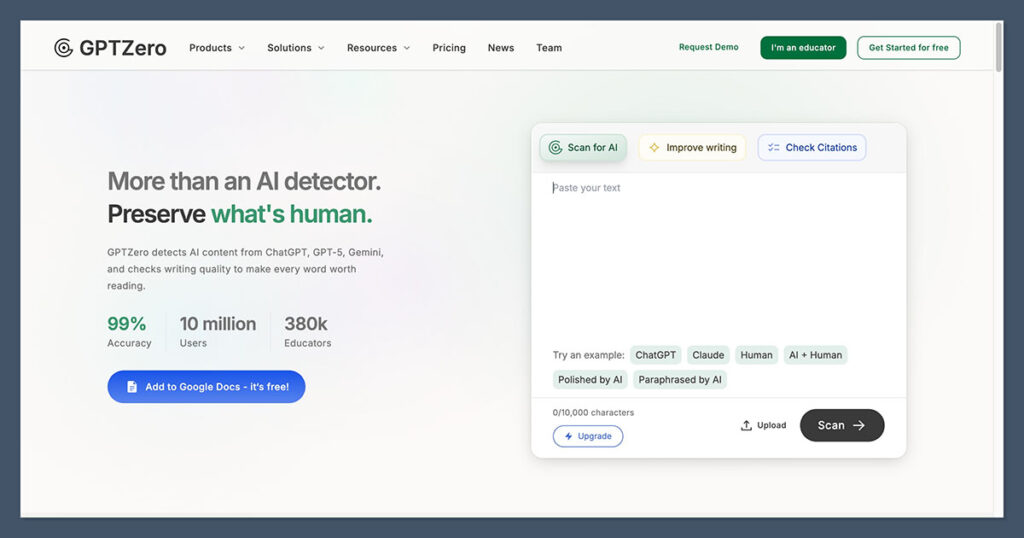
GPTZero is my top pick, and the only tool here that detects GPT-5 at 100% while still offering a real free tier. It earns the slot on the strongest independent standalone benchmark plus the most generous free allowance in the roundup.
Best for: educators and students.
Pros
- Free tier: 10,000 words/month, the most generous reputable free allowance here.
- Independent accuracy: RAID benchmark 95.7% recall at 1% FPR, the best independent standalone result in this lineup.
- Latest models: GPT-5 detection 100%, GPT-5-mini 94.9%, Claude Sonnet 4 99%.
- ESL fairness: de-biasing brings the TOEFL false-positive rate down to 1.1%.
- Authorship proof: Writing Replay records the keystroke and drafting process via a Google Docs extension.
- Compliance and LMS: FERPA and SOC2 Type II; integrates with Canvas, Moodle, and Google Classroom.
Cons
- Humanized text: only 52% on QuillBot-paraphrased AI in Scribbr’s test, the same weak spot that drags its overall Scribbr score to 52%.
- Real-world false positives: around 15% in some real-world university testing on student essays.
Pricing
- Free: 10,000 words/month (sign-up required)
- Essential: $14.99/month (150,000 words)
- Professional: $45.99/month (500,000 words)
The honest read on accuracy is the spread itself. RAID puts GPTZero at 95.7% on fresh AI text, but Scribbr’s corpus, which includes edited and humanized writing, drops it to 52%. Best for educators who want compliance plus free volume and students who want a free pre-check before submitting. Skip it if your main threat is paraphrased or humanized text, where Originality.ai is stronger.
2. Originality.ai: Best for Paraphrase Detection and Publishers
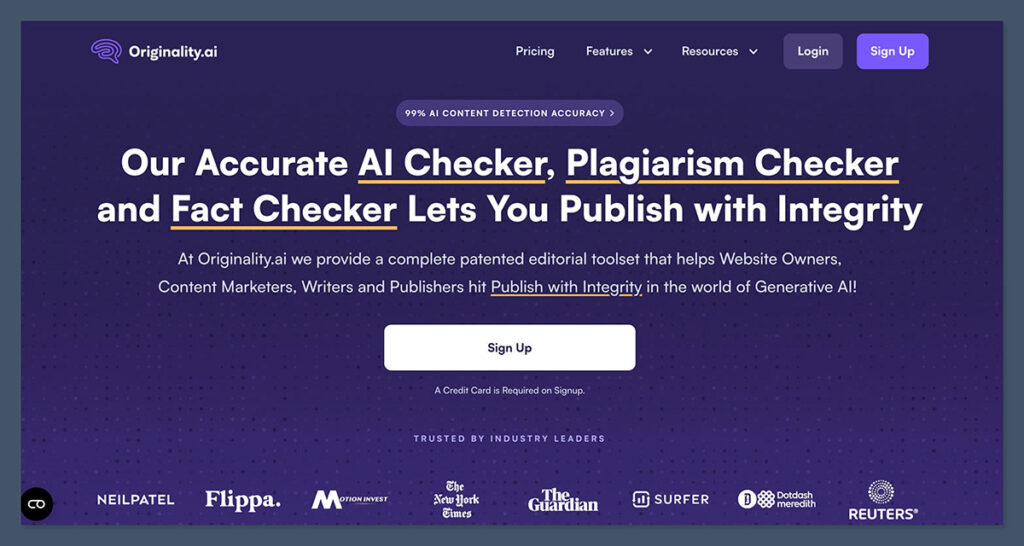
Originality.ai once scored the human-written Da Vinci Code as 100% AI, which tells you exactly where its edges are. It is also the best paraphrase-killer in this roundup, with plagiarism and readability bundled in.
Best for: content publishers and paraphrase detection.
Pros
- Paraphrase detection: 100% on QuillBot-paraphrased AI text, where GPTZero drops to 52%.
- Adversarial robustness: 96.7% on the RAID adversarial dataset.
- Academic track record: a meta-analysis of 15 studies put average accuracy at 91 to 100% across academic domains.
- Bundle: plagiarism check (claimed 99.5% vs Copyscape’s 68.5%), readability, and fact-checking in one scan, with a Chrome extension and WordPress plugin for workflow.
Cons
- No free tier: only 50 signup credits (about 5,000 words).
- GPT-5 blind spot: GPT-5-mini detection just 7.3%, GPT-5 only 31.7%.
- No compliance: no FERPA, no SOC2, and it auto-opts users into model-training data contribution, a problem for schools.
- False positives: flagged the Da Vinci Code at 100% AI; Scribbr independent test only 76%.
Pricing
- No free tier (50 signup credits)
- Pro: $14.95/month (2,000 credits)
- Pay-as-you-go: $30 one-time (3,000 credits)
The independent picture splits cleanly. Scribbr put it at 76% overall and RAID adversarial at 96.7%, yet it catches only 31.7% of GPT-5 output, so paraphrase strength and new-model weakness sit side by side. The verdict: great for publishers chasing spun freelance content, wrong tool for an academic-integrity workflow that needs FERPA and GPT-5 coverage.
3. Copyleaks: Best for Multilingual and Enterprise Scanning
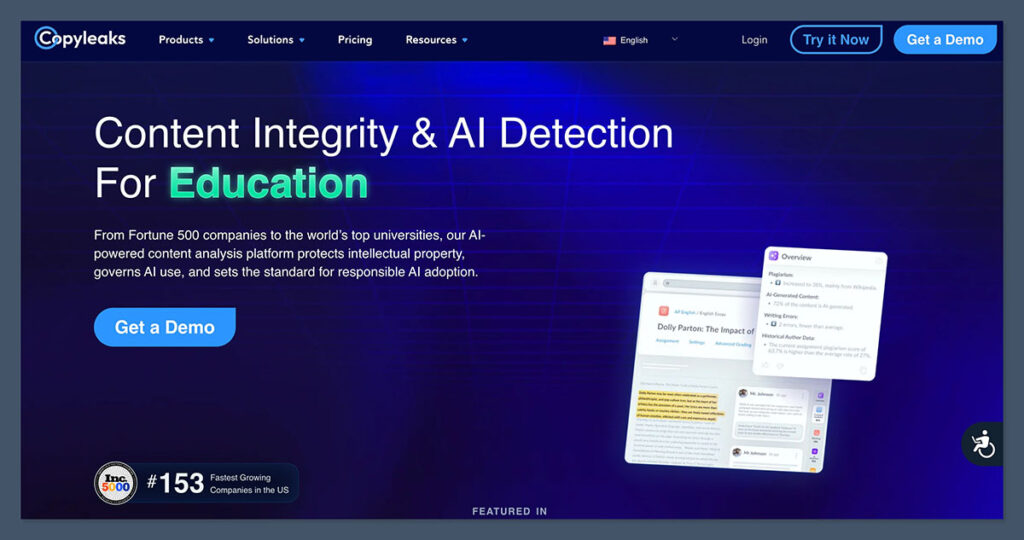
Copyleaks is the only pick here that handles 30+ languages and lets you dial false positives up or down. That flexibility is its real selling point, not raw accuracy.
Best for: multilingual and enterprise.
Pros
- Sensitivity control: three named modes (Extra Safe 0.009% FPR, Balanced 0.026%, Extra Sensitive 0.05%), so false-positive-averse users can tune strictness.
- Language coverage: 30+ languages plus multi-modal detection across text, images, video, and source code.
- Explainability: an “AI Logic” view surfaces flagged AI phrases and source matches rather than a bare percentage.
- Free scan volume: 25,000 characters free per scan, no login.
Cons
- Independent accuracy: Scribbr put it at only 66%, a 33-point gap below the 99.12% vendor claim.
- Humanized text: drops to 41% on humanized content.
Pricing
- Free: 25,000 characters per scan
- Paid: from $13.99/month (annual) or $16.99/month
There is a real tradeoff baked into those sensitivity modes. Extra Safe buys you a 0.009% false-positive rate, but overall accuracy already sits at 66% (and 41% on humanized text), so cranking down false positives further trades away recall. Best for multilingual institutions that will actually run Extra Safe mode. Skip it if you need high recall on edited or humanized text.
4. Turnitin: Best for Institutions, With Serious Caveats
The tool most schools already pay for is the one most schools are switching off. Turnitin still has the deepest institutional roots, but its AI score now comes with a long list of warnings, several from Turnitin itself.
Best for: institutions (with caveats).
Pros
- LMS integration: the deepest institutional and LMS integration of any tool here, native in Canvas, Blackboard, Moodle, and Google Classroom.
- Process evidence: Turnitin Clarity records the writing process (paste events, typing patterns, draft history) and was named a TIME Best Invention 2025, aligning neatly with the “signal, not sentence” thesis.
Cons
- ESL bias: Stanford measured a 61.3% false-positive rate on non-native English essays.
- Institutions disabling it: 12+ universities turned the detector off, including Vanderbilt, UC Berkeley, Yale, Johns Hopkins, Waterloo (September 2025), and Curtin (January 2026).
- Misleading accuracy claim: the vendor’s <1% false-positive figure only applies when AI content exceeds 20% of a submission.
- Access: institutional license only, with no individual signup.
Pricing
- Institutional licensing only (no public individual tier)
- Clarity available within institutional plans
The independent reality is rough: a 61.3% ESL false-positive rate, and a headline <1% claim that quietly excludes the borderline 1 to 19% range where most disputes happen. The verdict: lean on Clarity’s process recording, distrust the raw AI percentage, and never act on that number alone.
5. Winston AI: Best for Budget Agencies and Educators
Winston AI advertises 99.98% accuracy. Independent testing knocks roughly 15 to 25 points off that, which is the recurring vendor-versus-reality story this article keeps telling.
Best for: budget agencies and educators.
Pros
- Price-to-volume: $10/month (annual) for 80,000 words, the cheapest paid entry here.
- Extras: Google Classroom integration, OCR for scanned and handwritten work, a color-coded sentence-level AI Prediction Map, and a HUMN-1 human-content badge.
- Language coverage: 14 languages, useful for mixed-language classrooms.
Cons
- Inflated claim: advertises 99.98% but OriginalityReport.com independent testing puts it at 75 to 85%.
- No free tier: you have to pay to try it.
- Credit model: 1 credit equals 1 word, the least efficient pricing structure among the major tools.
Pricing
- No free tier
- $10/month billed annually for 80,000 words
- $26/month (annual) for 500,000 words
Called plainly, the 99.98% number does not survive contact with a real-world corpus, landing closer to 75 to 85%. Cheaper per word than GPTZero Pro, but you trade away the free tier and a verified chunk of accuracy to get there.
6. Scribbr: Best for Quick Student Pre-Submission Checks
Paste up to 1,200 words, no account, instant read. Scribbr is the frictionless free option, and it runs on GPTZero’s engine, so its results track a strong independent performer on fresh AI text.
Best for: quick student pre-submission.
Pros
- Free and no signup: unlimited checks up to 1,200 words per scan.
- Trusted engine: powered by GPTZero, so accuracy mirrors a tool that hits RAID 95.7% on fresh AI text.
Cons
- Length cap: 1,200 words per scan means longer essays get split into chunks.
- Shared weakness: inherits GPTZero’s humanized-text blind spot (around 52% in Scribbr’s own test).
Pricing
- Free; no paid tier needed for the core checker
Because it shares GPTZero’s engine, it shares both the strength (RAID 95.7%) and the weakness (52% on humanized text). Best for a student spot-checking a draft before submitting. Skip it if you need to scan a full thesis in a single pass.
7. QuillBot: Best for Students Already in the QuillBot Ecosystem
The maker of one of the web’s most popular paraphrasers ships a detector that its own paraphraser reliably defeats. That irony is also QuillBot’s biggest flaw.
Best for: students already in the QuillBot ecosystem.
Pros
- Free for short text: free for texts under 1,200 words, no signup.
- In-suite convenience: integrated with QuillBot’s paraphrasing, summarizing, and grammar tools.
Cons
- Worst humanized collapse: accuracy falls from 98% on raw AI to just 12% on humanized content, an 86-point drop and the steepest here.
- Self-defeating: the same company’s paraphraser reliably beats the detector.
Pricing
- Free under 1,200 words
- Bundled in QuillBot Premium (from $8.33/month annual) for batch upload
The 98%-to-12% collapse on humanized text tells you everything about its evidentiary value. The verdict: fine as a convenience check inside the QuillBot suite, useless as evidence, especially against paraphrased text.
8. ZeroGPT: Best for Zero-Friction Free Checks (Honorable Mention)
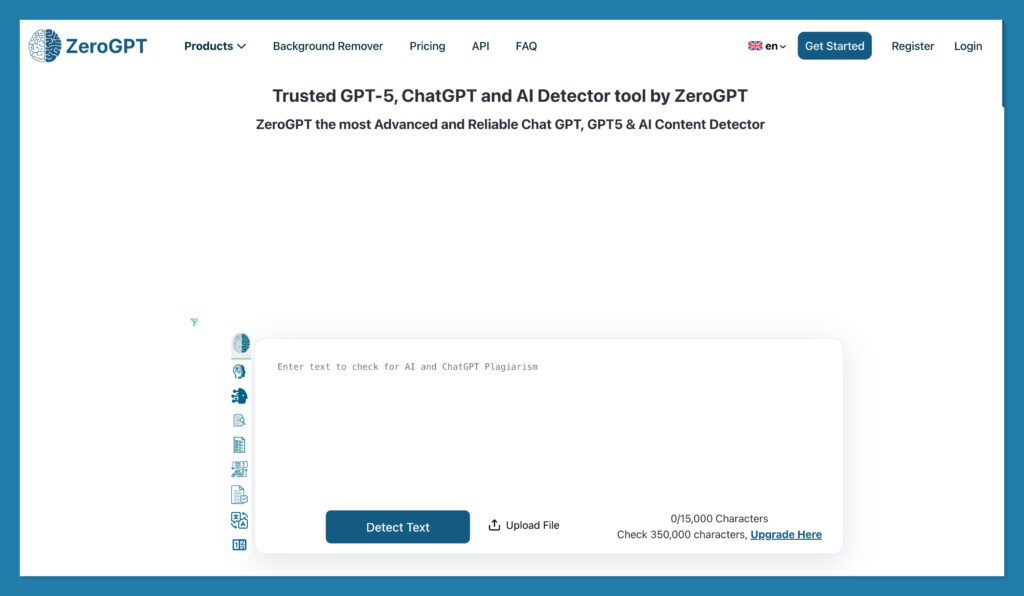
A short honorable mention, because ZeroGPT shows up constantly in search results and you deserve an honest read. A 28% false-positive rate means roughly one in four innocent essays could get flagged.
Best for: zero-friction free checks.
Pros
- Free and instant: 15,000 characters, no signup.
Cons
- Weak accuracy: 64% in Scribbr’s test.
- High false positives: up to 28% FPR in some independent assessments.
- No published validation: no transparent benchmark data.
Pricing
- Free, 15,000 characters, no signup
Use it for a throwaway gut-check. For anything that actually matters, Scribbr (also free, no signup) is the more trustworthy pick.
The Verdict: Which AI Essay Detector Should You Use?
After eight reviews, here is where I land, mapped to who you are:
Quick picks by use case
- Best overall / most accurate free detector: GPTZero (RAID 95.7%, 10,000 free words, 100% on GPT-5).
- Lowest false positives / ESL fairness: Copyleaks in Extra Safe mode (0.009% FPR), with GPTZero as the free alternative after de-biasing (1.1% FPR on TOEFL essays).
- Best for paraphrase / publishers: Originality.ai (100% on QuillBot-paraphrased text), with the GPT-5 caveat.
- Multilingual / enterprise: Copyleaks, for 30+ language coverage and multi-modal scanning.
- Institutions: Turnitin, but only via Clarity’s process recording, never the raw score.
- Quick free student check: Scribbr.
- Avoid for high-stakes decisions: QuillBot (98% to 12% humanized collapse) and ZeroGPT (28% FPR).
The core thesis holds across every one of these. No detector is accurate enough to prove misconduct. Vendor 97 to 99% claims collapse under Scribbr’s independent test (Originality 76%, Copyleaks 66%, GPTZero 52%), adversarial paraphrasing cuts detection by roughly 87.88%, and ESL essays were falsely flagged 61.3% of the time in the Stanford study.
So treat any score as a signal, not a sentence, and pair it with process evidence (draft history, Writing Replay, Turnitin Clarity). One concrete next step: if you are a student, run a free check before you submit. If you are an educator, corroborate with process evidence before you ever accuse.
AI Essay Detector FAQ: Accuracy, ESL Bias, and What to Do If Falsely Flagged
Are AI detectors accurate enough to prove academic misconduct?
No. Vendor claims of 97 to 99% collapse to 52 to 76% in Scribbr’s independent testing, and Perkins et al. (2024) measured baseline accuracy at just 39.5%. Turnitin’s own documentation warns its score should never be the sole basis for adverse student action, and 12+ universities have disabled detection over reliability concerns. A score can support an investigation, but it cannot prove how text was written.
Do AI detectors work on paraphrased text?
Poorly. A 2025 ArXiv study found adversarial paraphrasing cut detection rates by an average of 87.88% across all major detectors, and Perkins et al. (2024) saw accuracy fall from 39.5% to 22.1% with light editing. QuillBot’s own detector drops from 98% to 12% on humanized text. Originality.ai is the main exception at 100% on QuillBot-paraphrased content, though even it degrades on aggressively humanized writing.
Are AI detectors biased against ESL students?
Yes, significantly. Stanford’s Liang et al. (2023) found 61.3% of non-native English TOEFL essays falsely flagged, because simpler vocabulary and shorter sentences mimic the low-perplexity signature detectors hunt for. This is the AI detector false positives problem at its sharpest. Copyleaks Extra Safe mode (0.009% FPR) and GPTZero after de-biasing (1.1% FPR on TOEFL essays) are the fairer options.
What is the most accurate free AI detector?
GPTZero, thanks to a 10,000-words-per-month free tier, RAID 95.7% recall, and ESL de-biasing down to 1.1% on TOEFL essays. It is the strongest free option for students who want a real pre-submission check with sentence-level feedback. Scribbr is the best no-signup alternative, running GPTZero’s engine with unlimited scans up to 1,200 words.
Does a high AI score prove cheating?
No. A high score signals statistical likelihood that text resembles AI output, nothing more. It can be triggered by ESL writing patterns, heavy Grammarly editing, formal academic style, short length, or simply writing about a well-trodden topic. Treat it as a prompt for human review, then pair it with process evidence before drawing any conclusion.
Can AI detectors detect GPT-5?
It depends entirely on the tool. GPTZero detects GPT-5 at 100% and GPT-5-mini at 94.9%, while Originality.ai catches GPT-5 at only 31.7% and GPT-5-mini at a critical 7.3%. Since GPT-5-mini was the most popular OpenAI model in mid-2026, that gap matters. Tools that retrain frequently keep pace; others go effectively blind to new models.
What should I do if I’m falsely accused?
Gather process evidence first: Google Docs version history, timestamped drafts, research notes, outlines, and keystroke records (Writing Replay or Turnitin Clarity). If you are an ESL writer, cite the Stanford study showing a 61.3% false-positive rate on TOEFL essays and document your language background. Then submit a written rebuttal noting that 12+ universities have disabled these detectors, and request a human review. These AI detector false positives are well documented, and that precedent works in your favor.