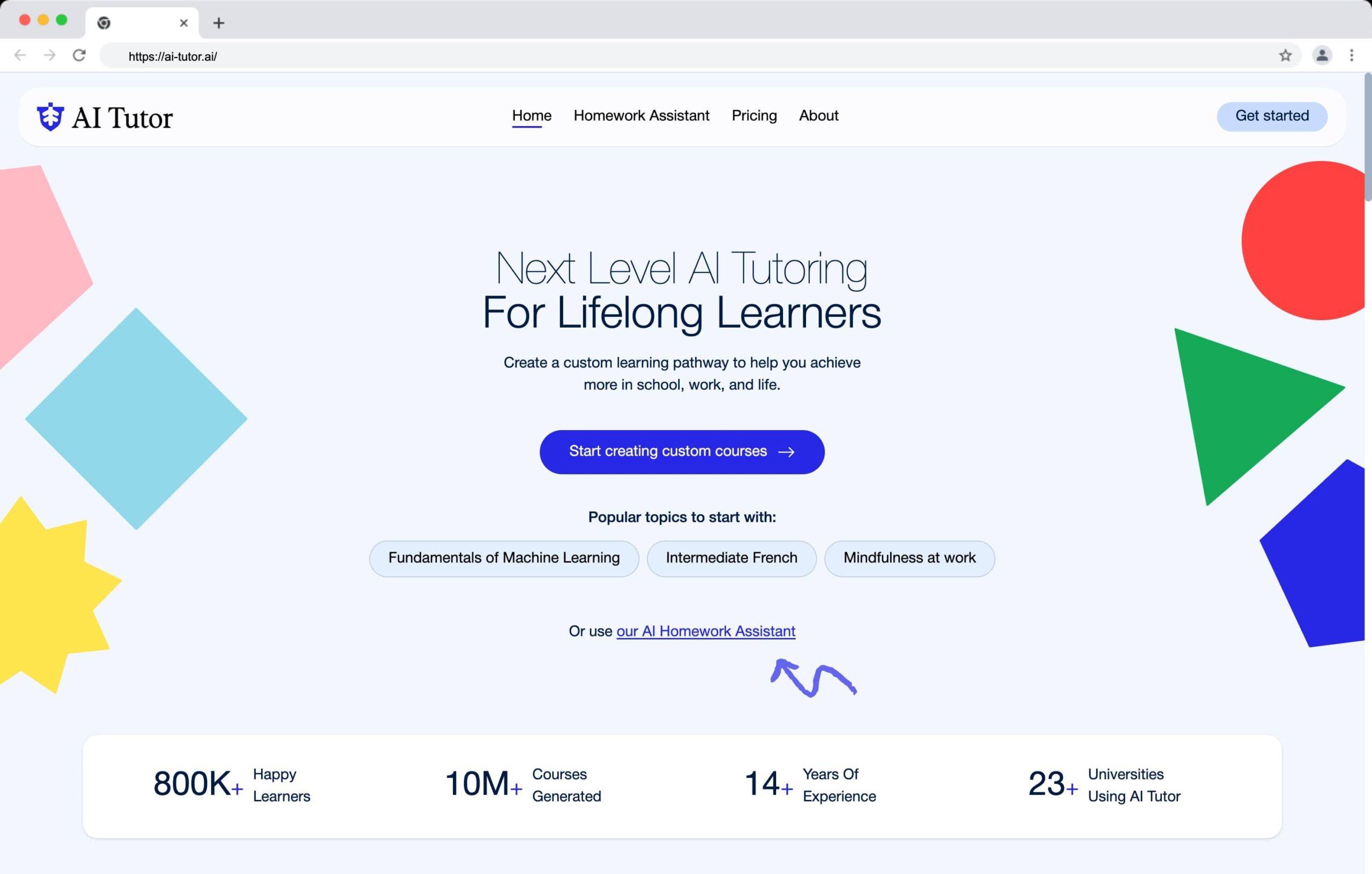
If you have spent any time looking at AI tutoring tools recently, you have probably seen three words used as if they meant the same thing: AI, AGI, and automation.
A platform calls itself an “AI tutor.” A vendor promises “near-AGI” personalisation. A school district talks about “automating feedback.” Most readers nod along, even though these three terms describe very different things.
The distinction matters for anyone choosing tools, building curriculum, or advising parents. It changes what you should expect, what you should pay for, and what you should never trust an AI to do alone in a learning environment.
This guide breaks down the three concepts in plain language, shows how they actually show up in tutoring products today, and explains why “AGI tutor” is still marketing rather than reality.
Key Takeaways
- Automation runs predefined tasks (sending reminders, grading multiple choice, scheduling sessions). It does not “understand” anything.
- Narrow AI is what powers every real AI tutor today: language models, recommender systems, and adaptive engines that work inside a specific domain.
- AGI is a hypothetical system that could learn and reason across any subject like a human teacher. No tutoring product on the market is AGI, regardless of how it is marketed.
- The strongest tutoring products combine narrow AI with old-fashioned automation, not a single magical model.
- For the foreseeable future, human teachers and tutors remain essential for context, motivation, and judgement that AI cannot reliably provide.
The Three Terms, Defined Simply
Automation
Automation is technology that carries out predefined, repeatable tasks with little human involvement. It follows rules. It does not learn, and it does not adapt unless someone reprograms it.
In a tutoring context, automation looks like:
- Sending a reminder email when a student misses a session.
- Auto-grading a multiple-choice quiz.
- Generating a weekly progress report based on logged scores.
- Moving a student to the next worksheet when they hit 80 percent accuracy.
None of this requires intelligence. It requires a workflow and a trigger. Automation has been embedded in education software for decades, long before the current AI wave.
Narrow AI (or just “AI”)
Narrow AI refers to systems that apply machine learning or related techniques to perform specific cognitive tasks inside a limited domain. It can handle ambiguity in ways automation cannot. It can also be wrong in ways automation cannot.
In tutoring, narrow AI is what allows a product to:
- Read a student’s free-text answer and judge whether it captures the right idea.
- Generate a hint tailored to the specific mistake a learner just made.
- Predict which topics a student is likely to struggle with next week.
- Hold a back-and-forth conversation about a maths problem.
- Translate a lesson into another language on demand.
Large language models, recommendation engines, speech recognition, and image classifiers all fall under narrow AI. They are powerful, but each one is built for a defined slice of work. A coding copilot cannot diagnose a learning disability. A spelling tutor cannot teach calculus.
AGI (Artificial General Intelligence)
AGI is a theoretical form of AI that could understand, learn, and apply knowledge across many domains at a level comparable to a competent adult human. It would learn new subjects from a few examples, transfer ideas between fields, plan over long time horizons, and act flexibly in unfamiliar situations.
An AGI tutor, if it existed, would not just be good at maths. It would be able to teach maths to a struggling eight-year-old in the morning, coach a teenager through a college application essay at lunchtime, and design a personalised physiotherapy programme for an injured athlete in the afternoon, while noticing when one of them seems anxious and adjusting accordingly.
No system on the market today does this. Frontier AI models can look impressive across many tasks, but they still fail at robust reasoning, struggle with novel problems, and lack the grounded understanding that genuine generality would require. AGI remains a research goal, not a product category.
Quick Comparison Table
| Aspect | Automation | Narrow AI | AGI |
|---|---|---|---|
| Main goal | Run repeatable tasks efficiently | Solve specific cognitive tasks well | Match human general intelligence |
| Scope | Fixed, rule-based | Domain-specific | Cross-domain, open-ended |
| Adaptability | Low (needs reprogramming) | Medium (can be retrained) | Very high (learns and transfers) |
| Tutoring examples | Auto-grading, scheduling, reminders | Conversational tutors, adaptive paths, essay feedback | Hypothetical “AI teacher” that can teach any subject to any learner |
| Current maturity | Mature and widely deployed | Rapidly evolving, in production | Research concept, not real yet |
| What it cannot do | Handle anything outside its rules | Reliably generalise outside its training | Exist (so far) |
What “AI Tutor” Actually Means Today
When you open most modern AI tutoring products, you are not interacting with a single intelligent entity. You are interacting with a stack of narrow AI components glued together by automation. Understanding that stack helps you evaluate any tool more honestly.
The typical AI tutor stack
- A large language model handles the conversation, generates explanations, and reformulates questions.
- A content engine pulls problems, examples, or lessons from a curated library.
- An adaptive layer (often a separate machine learning model) decides what to show the student next, based on their performance history.
- Automation rules handle the scaffolding: when to send a recap email, when to notify a parent, when to flag a struggling learner to a human tutor.
- Guardrails and filters sit on top to prevent inappropriate content, off-topic conversations, or factual drift on sensitive subjects.
None of these layers is “intelligent” in the AGI sense. Each one is narrow and predictable in its own way. The product feels intelligent because the pieces are well integrated.
Worth noting: When a tutoring product is described as “agentic” or “autonomous,” it usually means the system can chain several of these narrow components together to complete multi-step tasks. That is genuinely useful, but it is still narrow AI inside a workflow, not a step toward AGI.
Where automation does the heavy lifting
Plenty of “AI features” in tutoring platforms are actually automation in a smart wrapper. That is not a criticism. Automation is reliable and cheap to run. But it helps to know which is which.
- Practice generation: Some platforms generate questions on the fly using an LLM. Others select from a pre-built bank using rules. The student sees similar output; the underlying mechanism is very different.
- Progress reports: Often built from automation pulling structured data into a template. The AI part may just be a one-paragraph summary at the top.
- Adaptive learning paths: Sometimes powered by genuine machine learning, sometimes by branching logic that has existed for fifteen years. Vendors rarely make this distinction clear.
Why Genuine AGI Would Change Tutoring (and Why We Are Not There)
To see why current AI tutors are not AGI, it helps to look at what AGI would actually unlock in education and why today’s systems fall short on those criteria.
1. Generalisation across subjects and learners
An AGI tutor would learn a new curriculum, language, or pedagogy with minimal training data, then transfer those insights between students. Current AI tutors require their content libraries, prompts, and adaptive logic to be built out subject by subject, often grade by grade. A maths tutor that works beautifully for KS3 algebra needs significant rework to handle KS5 mechanics, let alone GCSE history.
2. Grounded understanding and reliable reasoning
AGI would maintain a coherent model of the world: cause and effect, physical constraints, social context. It would not invent plausible-sounding nonsense.
Today’s language models, by contrast, still hallucinate. They can confidently teach a student an incorrect formula, misattribute a historical event, or solve a maths problem with a wrong intermediate step that the student copies as truth. This is a serious risk in education, where the learner often cannot tell whether the explanation is accurate. Strong tutoring products work hard to limit this through content grounding, retrieval, and human review. The risk does not disappear.
3. Long-horizon planning and judgement
A human tutor notices when a student is bored, frustrated, or quietly losing motivation, then adjusts the plan over weeks, not minutes. They decide when to push, when to slow down, when to involve a parent, when to recommend testing for a learning difference. AGI would, in principle, do this kind of long-term, context-aware judgement. Narrow AI cannot. It optimises for what it can measure inside a single session.
4. Continual learning
An AGI tutor would update its knowledge continuously, the way a human teacher absorbs new exam specifications or new student feedback. Most production AI models today are essentially static between training runs. They learn from a fixed dataset, get fine-tuned, then sit at that level until the vendor decides to retrain. New facts, new pedagogy, and new mistakes do not flow back in automatically.
What This Means in Practice for AI Tutoring
For students and parents
- Treat AI tutors as practice partners, not authorities. They are excellent for reps, explanations, and on-demand help. They are not infallible teachers.
- Check the maths and the facts. Especially in subjects with definite right answers, verify against a textbook or a human.
- Expect best results in defined domains. Vocabulary drills, structured maths topics, coding practice, and language conversation are where narrow AI shines. Open-ended essay critique, ethical reasoning, and exam strategy benefit from a human in the loop.
For tutors and tutoring businesses
- Automate the boring parts first. Scheduling, reminders, payment, basic progress tracking. The ROI is immediate and the failure mode is mild.
- Use AI for high-volume, low-stakes work. Drilling practice, generating variations, explaining standard concepts, providing first-draft feedback.
- Keep humans on the high-stakes work. Diagnosing why a student is stuck, adjusting strategy over a term, managing parent relationships, and handling exam pressure.
- Be honest in your marketing. Calling a chatbot “AGI-powered” or “near-human” is a credibility problem waiting to happen. Calling it “an AI assistant that helps you practise” is more accurate and ages better.
For schools and curriculum designers
- Map every claim back to the stack. When a vendor says their product is “AI-powered,” ask which parts are LLMs, which are adaptive ML, which are rule-based. The answer reveals the real capability.
- Plan for fallibility. Build review steps into any workflow where an AI generates content shown to students.
- Invest in data hygiene. Both narrow AI and automation work better when the data feeding them is clean. This is unglamorous but often the highest-leverage move.
How to Spot Hype Versus Substance
When you see a tutoring product described in AI terms, run it through these quick checks.
What to ask a vendor
- “Which specific tasks use a machine learning model, and which use rules?”
- “How do you prevent the AI from giving students incorrect explanations?”
- “How is student progress data used to improve the model, and who has access to it?”
- “What happens when the AI is wrong? How does a human catch it?”
Red flags
- Marketing that uses “AGI” as a feature.
- Claims that the product “understands” the student in any deep sense.
- No mention of human oversight, content review, or error rates.
- Vague answers about which subjects, age groups, or curricula the system has been validated for.
Green flags
- Clear scope: “This works best for X subject, Y level, Z type of student.”
- Transparency about model limitations and hallucination risks.
- Human tutors or reviewers available as a backstop.
- Evidence (case studies, evaluations, third-party research) tied to specific learning outcomes.
The Bottom Line
AI, AGI, and automation are not interchangeable. Today’s AI tutors are narrow AI components stitched together with traditional automation. They are genuinely useful for practice, feedback, and access at scale.
They are not general intelligences, and they are not replacements for skilled human teachers.
The most effective tutoring setups in the next few years will not be the ones that chase AGI marketing. They will be the ones that pair narrow AI with thoughtful automation and keep humans in the seats where judgement, motivation, and care actually matter.
FAQ
Is ChatGPT an AGI?
No. ChatGPT and similar large language models are powerful examples of narrow AI. They handle a remarkably wide range of language tasks, which can make them feel general, but they still lack robust reasoning, grounded understanding, and reliable behaviour across truly novel domains. Researchers and labs themselves describe AGI as a future goal, not something currently shipped.
Can an AI tutor replace a human teacher?
Not for most students, and not for the full job. AI tutors can replace certain parts of what a teacher does, such as drilling practice questions, providing immediate explanations, and offering on-demand help outside school hours. They cannot reliably handle motivation, long-term planning, pastoral care, or nuanced judgement about a child’s development. The best results come from combining AI tools with human teaching, not from replacing one with the other.
What is the difference between an AI tutor and an adaptive learning platform?
Adaptive learning platforms have existed for years and often rely on rule-based logic or traditional machine learning to decide what to show a student next. Modern AI tutors usually add a conversational layer powered by a large language model on top of that adaptive engine. In short, adaptive learning chooses the next thing to study; AI tutors also let the student talk through it.
Will AGI eventually arrive in education?
Maybe, but the timeline is highly uncertain. Some researchers expect human-level general AI within this decade; others see it as a much longer-term goal or doubt it will arrive in a recognisable form at all. Either way, betting an educational strategy on AGI today is risky. Building around proven narrow AI and solid automation is the more reliable path.
Is automation in education the same as AI?
No. Automation runs fixed, rule-based tasks: sending reminders, scheduling sessions, grading multiple choice, generating standard reports. AI involves machine learning models that handle ambiguity, generate language, or adapt to patterns in data. Many tutoring products use both, but they are distinct technologies with different strengths and failure modes.
How should I evaluate an AI tutoring product as a parent?
Look for clarity about what the product actually does, what subjects and ages it is built for, how it handles mistakes, and whether human support is available. Try it yourself before recommending it to your child. Pay attention to whether the explanations are accurate and whether the product encourages your child to think, rather than just hand over answers.