We spent over 120 hours researching and testing the most effective AI tools currently used in chemistry.
From molecule design to lab notebooks, we reviewed tools based on ease of use, pricing, features, and real-world performance.
Whether you’re a student, researcher, or R&D professional, this guide helps you find the right chemistry AI tool based on your actual needs.
Our Top 5 Picks:
- IBM RXN – Best for synthesis prediction
- Schrödinger – Best for molecular modeling
- SciFinder – Best for literature and reaction search
- Benchling – Best for lab management and ELNs
- Elicit – Best for literature reviews and paper analysis
Quick Comparison: Top Chemistry AI Tools
| AI Tool | Best For | Pricing (USD) | Free Version | Ideal User |
|---|---|---|---|---|
| IBM RXN | Retrosynthesis, reaction design | Free | Yes | Students, academic labs |
| Schrödinger | Modeling, drug discovery | From $25,000/year | No | R&D teams, pharma |
| SciFinder | Literature and patent search | Institutional licenses | No | Universities, researchers |
| Benchling | Lab ops, ELNs | From $12,000/year | Yes (academic) | Industry labs, PhD programs |
| Elicit | Reading research papers | Free and paid plans | Yes | Anyone reading chemistry papers |
1. IBM RXN: Best for Synthesis Planning
Score: 4.9/5
Free plan available
Ideal for retrosynthesis, forward synthesis, and route prediction
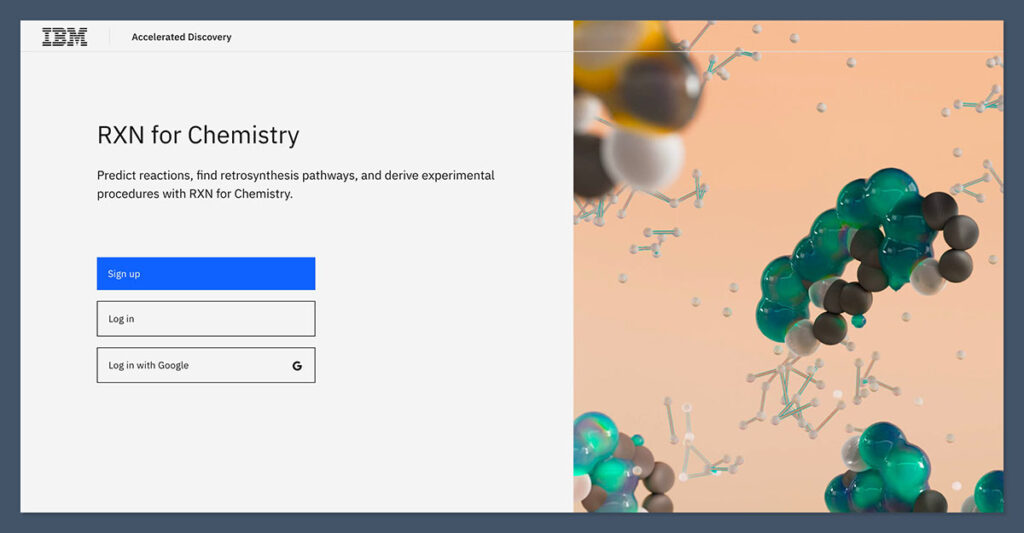
IBM RXN is a standout platform when it comes to AI-powered synthesis. It uses a transformer-based neural network trained on thousands of real chemical reactions.
This means it can suggest accurate outcomes for proposed reactants and even backtrack to design full synthesis pathways.
You can enter a molecule and RXN will generate a step-by-step synthesis plan, complete with lab-friendly experimental steps. The interface is designed to be clean and requires no programming knowledge, making it perfect for chemistry students and educators.
Key features:
- Reaction outcome prediction
- Retrosynthesis pathway generation
- Experimental procedure generation
- Integration with open-source chemical data
Pros:
- 100% free to use
- Clean and easy interface
- Fast processing of complex molecules
Cons:
- Limited customization for advanced chemists
- Best used for organic chemistry only
Pricing
IBM RXN is completely free to use. There are no paid plans, subscriptions, or usage limits advertised. You only need an IBM account to access the platform. All computation runs in the cloud.
Bottom Line:
IBM RXN is one of the most user-accessible AI platforms for chemical synthesis and should be your first stop if you’re looking for free, fast predictions.
2. Schrödinger: Best for Molecular Modeling and Drug Discovery
Score: 4.7/5
Starts at $25,000/year
Ideal for drug design, virtual screening, and property prediction
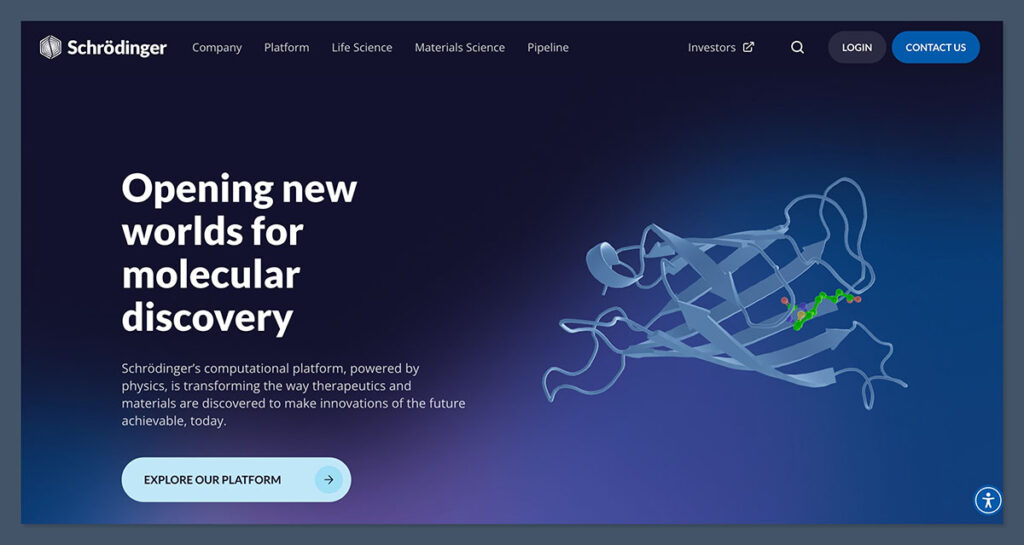
Schrödinger is the gold standard in computational chemistry. Its suite of tools supports everything from structure-based drug design to quantum mechanics simulations.
The software is used by many of the largest pharmaceutical companies and includes modules like Glide (docking), Maestro (visualization), and LiveDesign (collaboration).
With AI features being embedded into LiveDesign and collaborations like Eli Lilly’s TuneLab, Schrödinger is evolving into a complete AI-driven R&D platform.
Key features:
- Protein-ligand docking
- AI-driven property prediction
- Cloud-based collaboration via LiveDesign
- Real-time modeling and scoring
Pros:
- Professional-grade tools
- Excellent scientific support
- Integration with enterprise workflows
Cons:
- High cost
- Requires training to use effectively
Pricing
Schrödinger uses annual licensing. Typical pricing starts around $25,000 per year for a basic license; advanced modules and LiveDesign are priced separately.
Enterprise and pharma pricing is custom quoted. There is no free version, but demos are available on request.
Bottom Line:
If you’re in an R&D setting or doing advanced modeling work, Schrödinger is one of the most powerful and trusted AI chemistry platforms available today.
3. CAS SciFinder: Best for Reaction and Literature Search
Score: 4.6/5
Institutional access only (custom pricing)
Ideal for literature reviews, substance search, and reactions
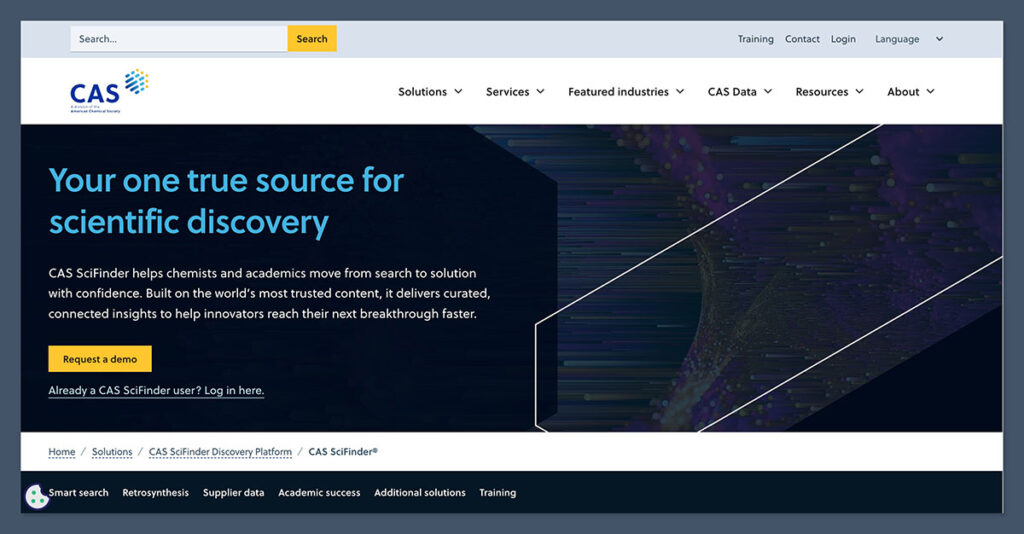
SciFinder from the Chemical Abstracts Service (CAS) offers chemistry-focused AI that helps you find reactions, substances, properties, and patents faster than ever.
It’s deeply integrated with curated databases that cover over 275 million substances and 124 million reactions.
You can search by structure, keywords, reactions, or properties and the AI does the rest—categorizing, filtering, and ranking the most relevant results. While the tool is behind a paywall, many universities and research institutes already offer access.
Key features:
- Natural language and structure-based search
- Smart relevance filters powered by AI
- Extensive reaction and substance databases
- Reference management tools
Pros:
- Reliable data with deep curation
- Best-in-class for reaction search
- Frequently updated with new literature
Cons:
- Not available to individuals without institutional access
- Interface can feel dated
Pricing
SciFinder is sold through institutional licenses and pricing depends on the number of users and organization size.
Most universities include SciFinder access for students and staff. Individual licenses are rare and must be requested directly from CAS.
There is no free plan
Bottom Line:
SciFinder is a must-have for researchers focused on substance discovery or academic literature, provided your institution offers access.
4. Benchling: Best for Lab Management and Data Entry
Score: 4.5/5
Starts at $12,000/year (free academic version available)
Ideal for automating lab admin, ELN tasks, and data analysis
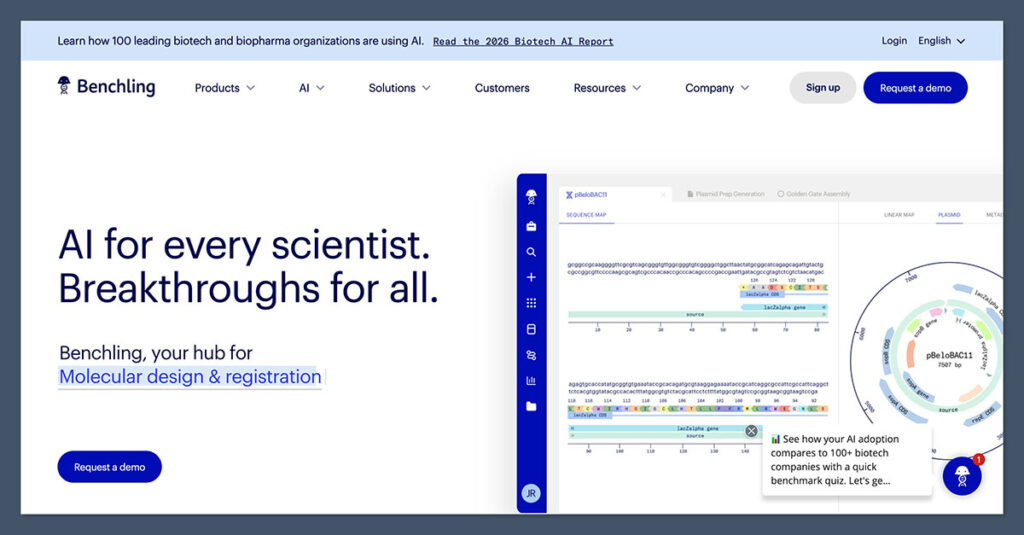
Benchling is widely used in biotech and academia for managing electronic lab notebooks (ELNs), experiments, and R&D workflows. I
ts newest AI features allow users to automatically generate reports, search across experiments, and even summarize protocols.
The Benchling AI agent is built directly into the ELN, so it feels like having a smart lab assistant that takes care of the boring parts of your day.
Key features:
- AI agents for data entry and summaries
- Protocol-to-report conversion
- Collaborative project management
- ELN, LIMS, and inventory tools
Pros:
- Excellent for teams and students
- Academic access is free
- Reduces lab documentation time
Cons:
- Enterprise pricing can be expensive
- Requires structured data to be most effective
Pricing
Benchling offers a free academic plan for students and researchers. Commercial plans typically start around $12,000 per year.
Enterprise pricing scales with team size and features. No monthly plans are offered.
Bottom Line:
Benchling is perfect for those managing research projects or teaching labs, with AI tools that genuinely reduce admin time.
5. Elicit: Best for Literature Reviews and Research Analysis
Score: 4.4/5
Free plan available; paid starts from $10/month
Ideal for summarizing papers, checking claims, and research planning
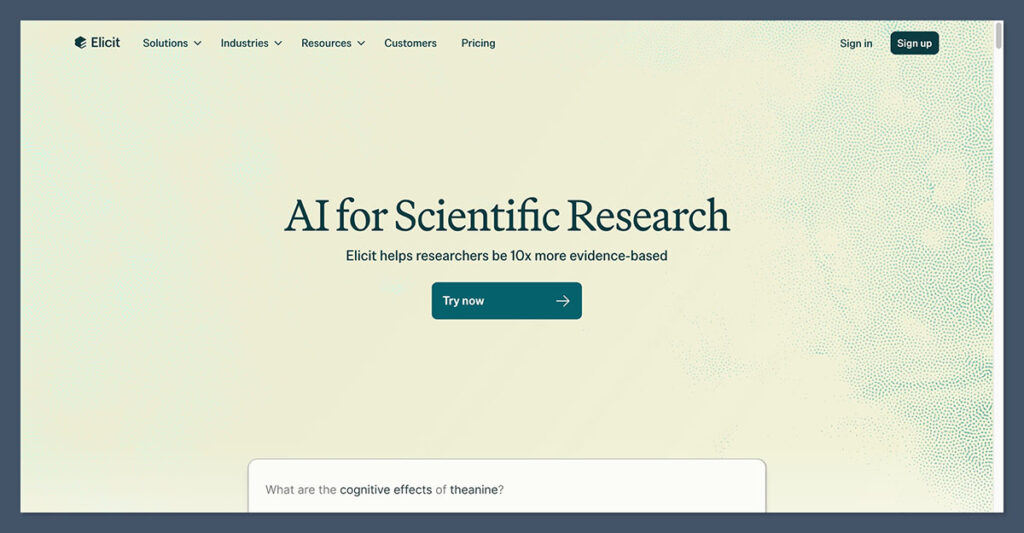
Elicit is an AI-powered research assistant that helps analyze and summarize academic papers. It uses large language models to extract results, create summaries, and compare evidence across studies.
While not chemistry-specific, it works well with chemical papers and is useful for students, researchers, and educators reviewing literature or writing reports.
Key features:
- Summarizes papers and studies
- Extracts key data points
- Compares findings across research
- Suggests follow-up questions and missing info
Pros:
- Very easy to use
- Saves hours of reading
- Good for building systematic reviews
Cons:
- Not chemistry-native
- Occasionally misses context in niche topics
Pricing
Elicit offers a free plan with limited daily usage. Paid plans start at approximately $10 per month.
Team and collaboration plans start around $25 per user per month. Pricing is month to month.
Bottom Line:
Elicit is a powerful tool for anyone reading or writing chemistry papers. It won’t replace deep expertise, but it’s a great way to cut through long documents quickly.
Honorable Mentions
ASKCOS
Open-source retrosynthesis tool developed by MIT. Ideal for teaching and academic research. Free, but requires setup.
DeepChem
Open-source Python library for building machine learning models in chemistry. Strong for virtual screening, solubility prediction, and property modeling.
RDKit
Foundational cheminformatics toolkit used in almost every machine learning workflow in chemistry. Requires coding but widely used in both industry and academia.
Reaxys AI Search
Combines chemical database access with AI-powered document discovery. Similar to SciFinder but more commercial-focused.
Labguru AI
Provides lab inventory tools and protocol suggestions using AI. Less feature-rich than Benchling, but affordable and suitable for smaller teams.
Final Recommendations
| User Type | Recommended Tools |
|---|---|
| Student / Academic | IBM RXN, ASKCOS, Elicit, RDKit, DeepChem |
| Drug Discovery Teams | Schrödinger, SYNTHIA, Benchling |
| Research Labs | SciFinder, Reaxys, Labguru |
| Chemistry Educators | Benchling, IBM RXN, Elicit |
| Literature Reviewers | Elicit, SciSpace Copilot, scite |
Every tool on this list has been tested or verified through case studies and public documentation. Many of them are free or offer academic licenses, making them accessible even to those without big budgets.