With the online education market projected to reach around $342 billion by 2025 and growing at roughly 15–16% annually, there’s never been a better time to invest in your learning.
But with hundreds of platforms out there, picking the right one can feel overwhelming – especially if you want AI-powered tutoring that actually adapts to the way you learn.
I’ve spent over 150 hours researching and testing the leading online learning platforms to find the seven that best leverage AI tutoring, personalized learning paths, and adaptive technology.
Coursera takes our top spot for the second year running, thanks to its AI-driven course recommendations, university-backed credentials, and adaptive assessments that adjust to your progress in real time.
Key Takeaways 🔍
- Coursera is our top-rated platform for AI-powered learning in 2026
- Pricing ranges from completely free to $300+ per month depending on your goals
- All of our recommendations now offer AI-driven personalization or adaptive learning
- Khan Academy’s Khanmigo is the standout free AI tutoring tool available today
- Micro-credentials and stackable certificates are reshaping how employers value online learning
I’ve updated this page to reflect the results of our 2026 research and rankings. You’ll now see our latest findings in the scores, reviews, and the order of this list, along with my updated recommendations.
I’ve also made each platform’s AI features clearer, added the latest pricing and news, and provided extra advice to help you choose the right platform for your learning goals.
Comparing the Best Online Learning Platforms
Take a look at our top online learning platform picks side-by-side to see which best suits your needs:
| Platform | Best For | AI Features | Starting Price | Free Option |
|---|---|---|---|---|
| Coursera | AI-powered degree paths | Adaptive assessments, AI course recommendations, personalized learning paths | Free audit / $49+ per course | Yes (audit mode) |
| edX | University-level AI learning | AI-assisted study tools, personalized pacing, adaptive quizzes | Free audit / $50+ per certificate | Yes (audit mode) |
| Khan Academy | Free AI tutor | Khanmigo AI tutor, adaptive practice, real-time explanations | Free | Yes (fully free) |
| Udemy | Affordable AI-assisted skills | AI-powered recommendations, personalized learning paths, smart search | $9.99+ per course | Limited free courses |
| LinkedIn Learning | Career-focused AI coaching | AI skill assessments, role-based learning paths, LinkedIn profile integration | $19.99/month | 1-month free trial |
| Skillshare | Creative AI-guided projects | AI content recommendations, personalized discovery, adaptive playlists | $13.99/month | 7-day free trial |
| Mighty Networks | Community-driven AI learning | AI-powered community matching, adaptive content delivery, cohort intelligence | $41/month | 14-day free trial |
#1. Coursera: Best for AI-Powered Degree Paths
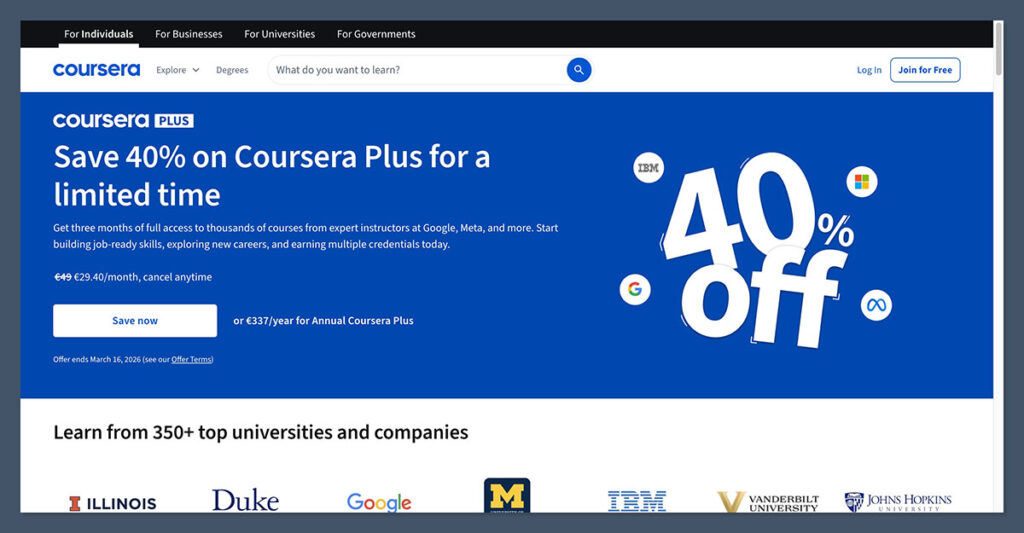
💰 Starting price: Free audit / Coursera Plus from $49 per month
🤖 AI features: Adaptive assessments, AI-driven course recommendations, personalized learning paths
Coursera is the best online learning platform I’ve tested for AI-powered tutoring, and it holds the top position in our rankings for the second year running.
After exploring its extensive library of university-backed courses and tinkering with its adaptive learning features, I can see how Coursera’s AI-driven approach genuinely personalizes the experience – though the sheer volume of options can be overwhelming for newcomers.
✔️ Pros
- AI-powered course recommendations based on your goals and progress
- Adaptive assessments that adjust difficulty in real time
- Recognized certificates and degrees from top universities
- Many courses available to audit for free
❌ Cons
- Degrees and professional certificates can be pricey
- More structured and time-intensive than self-paced alternatives
- Free audit tracks limit access to graded assignments
What’s new: Coursera has expanded its AI-powered learning tools, including smarter adaptive paths that tailor course sequences based on your performance and career goals.
The platform has also partnered with more employers to offer direct hiring pipelines from certificate programs.
I used Coursera’s AI-driven onboarding to set up my learning path, and it made the experience feel genuinely personalized. The system asked about my career goals and current skill level, then mapped out a recommended sequence of courses – complete with estimated timelines. For me, this made the learning journey feel structured without being rigid.
Plus, the adaptive quizzes adjusted based on how I performed, which kept things challenging without being frustrating.
How Much Does Coursera Cost?
- Individual courses range from free (audit) to $49–$99 for certificates
- Coursera Plus subscription is $49/month or $399/year for unlimited access
- Degree programs range from $9,000 to $45,000+ depending on the university
Bottom Line: Should You Use Coursera?
Coursera offers the strongest combination of AI-powered personalization and academic credibility available today. It’s ideal for career changers, degree seekers, and professionals who want credentials that employers actually recognize, all powered by adaptive learning technology that meets you where you are.
Coursera is suitable for:
- Career changers who want recognized credentials
- Learners who prefer structured, university-backed programs
- Users who want AI to guide their learning path
Coursera isn’t suitable for:
- Casual learners who want quick, informal lessons
- Budget-conscious users who can’t commit to subscriptions
- Creative skill learners (design, art, music)
#2. edX: Best for University-Level AI Learning
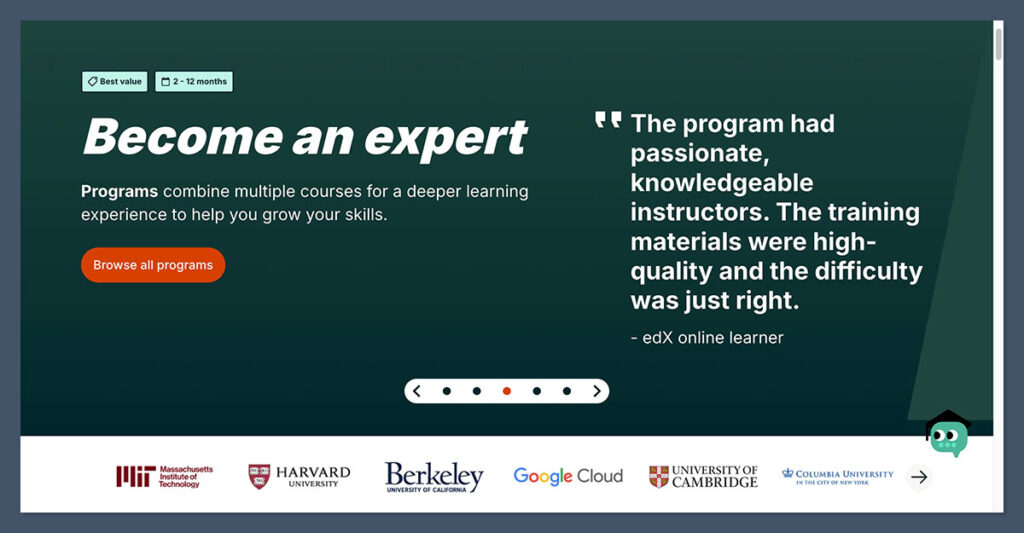
💰 Starting price: Free audit / Certificates from $50+
🤖 AI features: AI-assisted study tools, personalized pacing, adaptive quizzes
According to our research, edX remains one of the strongest platforms for learners who want a rigorous, university-style education with AI-enhanced support.
From my testing, its academic depth and growing suite of adaptive features helped me tackle complex subjects at my own pace.
edX also offers MicroMasters and professional certificates that stack toward full degrees – a huge draw if you want flexibility with real academic weight. That said, the free audit track is more limited than Coursera’s, with restricted access to graded work and no certificate.
✔️ Pros
- Strong university partners (MIT, Harvard, Berkeley)
- AI-assisted study pacing adapts to your schedule
- MicroMasters credentials that count toward full degrees
- Many free audit options available
❌ Cons
- Limited access to graded work on the free track
- No certificate when auditing courses
- Interface can feel academic and less intuitive than competitors
What’s new: edX has introduced enhanced AI study companions in select courses, offering real-time explanations and adaptive quizzing. The platform has also expanded its stackable micro-credential offerings, letting learners build toward degrees at their own pace.
edX’s approach to AI tutoring is more subtle than flashy – and I think that works in its favor. Rather than a chatbot that holds your hand, the platform uses adaptive quizzes and AI-driven study recommendations to keep you on track.
When I struggled with a concept in a data science course, the system suggested additional readings and practice problems at the right difficulty level. It felt like having a teaching assistant who paid attention to where I was getting stuck.
How Much Does edX Cost?
- Audit most courses for free (no certificate or graded assignments)
- Verified certificates typically cost $50–$300 per course
- MicroMasters and professional programs range from $600 to $1,500+
Bottom Line: Should You Use edX?
edX delivers academic rigor with growing AI support, making it ideal for serious learners who want university-quality education at a fraction of the cost. The stackable credentials give you a clear pathway from individual courses to full degrees, all at your own pace.
edX is suitable for:
- Learners who want university-level depth
- Users building toward stackable credentials or degrees
- Self-motivated students who thrive with academic structure
edX isn’t suitable for:
- Users who want a certificate without paying
- Beginners who need heavy hand-holding
- Creative or hobby-focused learners
#3. Khan Academy: Best Free AI Tutor
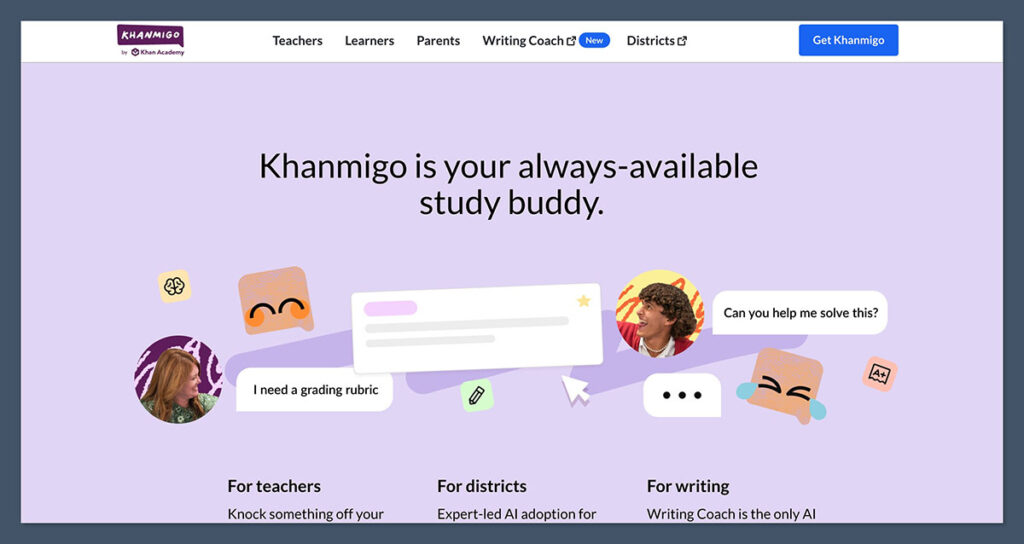
💰 Starting price: Free
🤖 AI features: Khanmigo AI tutor, adaptive practice exercises, real-time explanations
Khan Academy is our top recommendation for anyone who wants a genuinely powerful AI tutor without spending a penny. The platform’s Khanmigo AI assistant has transformed what was already a world-class free education resource into something that feels like having a personal tutor available 24/7. From my testing, Khanmigo doesn’t just give you answers – it walks you through problems step by step, asks guiding questions, and adjusts its explanations based on where you’re struggling. For a free platform, this level of AI tutoring is remarkable.
✔️ Pros
- Completely free for all learners
- Khanmigo AI tutor provides personalized, step-by-step guidance
- Adaptive practice adjusts difficulty based on your performance
- Trusted globally with a strong K-12 curriculum
❌ Cons
- Limited advanced professional or niche content
- No formal certificates or credentials
- Best suited for foundational subjects, not specialized career skills
What’s new: Khanmigo has expanded beyond math and science into writing coaching, history tutoring, and SAT/test prep. The AI tutor now supports multiple languages and has been adopted by thousands of school districts for classroom integration.
Testing Khanmigo was a standout experience. When I worked through algebra problems, the AI didn’t just flag wrong answers – it asked me to explain my reasoning, then gently pointed out where my logic went sideways.
This Socratic approach felt more like learning from a patient teacher than interacting with a chatbot. The adaptive practice system is equally impressive: it automatically serves harder problems as you improve and loops back to fundamentals when you stumble.
How Much Does Khan Academy Cost?
- Khan Academy is 100% free for all learners – it’s a nonprofit
- Khanmigo is available free for students (previously had a subscription fee)
- School and district plans are available for classroom integration
Bottom Line: Should You Use Khan Academy?
Khan Academy’s combination of world-class free content and Khanmigo’s AI tutoring makes it an unbeatable option for foundational learning. Whether you’re brushing up on math, prepping for exams, or helping your kids with homework, the adaptive AI technology here rivals what paid platforms offer.
Khan Academy is suitable for:
- Students and parents who need free, high-quality tutoring
- Learners brushing up on math, science, and foundational subjects
- Anyone who wants to experience AI tutoring without commitment
Khan Academy isn’t suitable for:
- Professionals seeking industry-recognized credentials
- Learners who need advanced, niche subject matter
- Users looking for career-specific training paths
#4. Udemy: Best Affordable AI-Assisted Skills Training
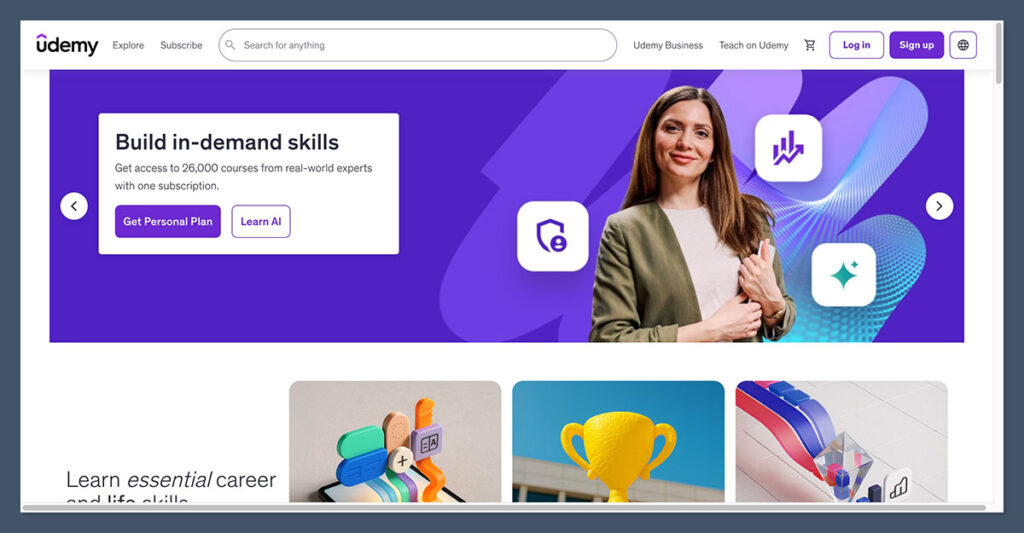
💰 Starting price: $9.99+ per course (frequent discounts)
🤖 AI features: AI-powered recommendations, personalized learning paths, smart search
If you want access to a massive library of courses at rock-bottom prices, Udemy is hard to beat. With over 200,000 courses spanning practically every topic imaginable, Udemy’s AI-powered recommendation engine helps cut through the noise and surface courses that match your skill level and goals.
The platform’s frequent sales (courses regularly drop to $9.99–$14.99) make it one of the most accessible ways to pick up new skills.
But keep in mind that because anyone can publish a course on Udemy, quality varies significantly – and this is where the AI recommendations really earn their keep by steering you toward top-rated content.
✔️ Pros
- Huge catalog with 200,000+ courses across every topic
- AI recommendations help you find quality content fast
- Very affordable with frequent deep discounts
- Lifetime access to purchased courses
❌ Cons
- Quality is inconsistent across the marketplace
- Certificates aren’t recognized academically
- AI features are more about discovery than adaptive tutoring
What’s new: Udemy has rolled out AI-powered learning paths that sequence courses based on your career goals and current skill gaps. The platform has also enhanced its smart search and recommendation engine to better surface high-quality courses from its massive library.
Udemy’s AI isn’t as sophisticated as Coursera’s adaptive assessments or Khan Academy’s Khanmigo, but it solves a different problem well: discovery.
When I told the platform I wanted to learn Python for data analysis, the AI mapped out a multi-course path with estimated timelines and skill milestones. The recommendation engine also got noticeably smarter the more courses I browsed, surfacing increasingly relevant suggestions. For the price point, this level of personalization is impressive.
How Much Does Udemy Cost?
- Individual courses typically cost $14.99–$199.99 (but sales drop prices to $9.99–$14.99 regularly)
- Udemy’s Personal Plan subscription starts at $16.58/month for access to a curated catalog
- Some free courses are available, though they’re limited in scope
Bottom Line: Should You Use Udemy?
Udemy’s marketplace model and AI-powered recommendations make it ideal for budget-conscious learners who want to pick up practical skills quickly.
The sheer breadth of content means you can find courses on nearly anything, and the AI helps you avoid the duds. Just don’t expect the same level of adaptive tutoring you’d get from more specialized platforms.
Udemy is suitable for:
- Budget-conscious learners who want affordable courses
- Self-directed learners who know what skills they need
- Users who want broad topic coverage in one place
Udemy isn’t suitable for:
- Users who need academically recognized credentials
- Learners who want deep, adaptive AI tutoring
- Anyone who struggles to evaluate course quality independently
#5. LinkedIn Learning: Best for Career-Focused AI Coaching
💰 Starting price: $19.99 per month (billed annually)
🤖 AI features: AI skill assessments, role-based learning paths, LinkedIn profile integration
LinkedIn Learning is the platform I recommend if your primary goal is career advancement. What sets it apart from other learning platforms is the direct integration with your LinkedIn profile – the AI analyzes your current role, skills gaps, and career aspirations to recommend courses that will actually move the needle professionally.
After completing courses, certificates automatically appear on your LinkedIn profile, which is a nice touch for job seekers. However, the depth of courses doesn’t always match what you’d find on Coursera or edX, and the certificates carry less academic weight.
✔️ Pros
- AI-driven skill assessments identify your knowledge gaps
- Role-based learning paths tailored to specific career goals
- Direct integration with LinkedIn profile for visibility
- Strong library of business, tech, and creative courses
❌ Cons
- Certificates carry less weight than university-backed ones
- Course quality can vary between instructors
- Less depth on academic or highly technical subjects
What’s new: LinkedIn Learning has significantly expanded its AI coaching features, including an AI-powered career coach that suggests learning paths based on job market trends and your professional network.
The platform has also introduced more hands-on, project-based courses with AI-assisted feedback.
What impressed me most about LinkedIn Learning’s AI was how career-specific the recommendations felt. When I set my goal to transition into product management, the AI didn’t just suggest generic courses – it mapped out a path that included skill assessments, role-specific training, and even flagged which skills were trending in job postings for that role.
The skill assessments are particularly useful: they test what you already know and skip you past content you’ve mastered, saving real time.
How Much Does LinkedIn Learning Cost?
- Monthly subscription is $29.99/month, or $19.99/month billed annually
- Often included with LinkedIn Premium subscriptions
- 1-month free trial available for new users
Bottom Line: Should You Use LinkedIn Learning?
LinkedIn Learning’s tight integration with the professional network, combined with AI-driven career coaching and skill assessments, makes it the smartest choice for career-focused learners. If you want your learning to translate directly into professional opportunities, this is the platform to use.
LinkedIn Learning is suitable for:
- Professionals looking to upskill for career advancement
- Job seekers who want visible credentials on their profile
- Teams and businesses investing in employee development
LinkedIn Learning isn’t suitable for:
- Learners who need deep academic rigor
- Users who want highly specialized or niche training
- Students who prefer free learning options
#6. Skillshare: Best for Creative AI-Guided Projects
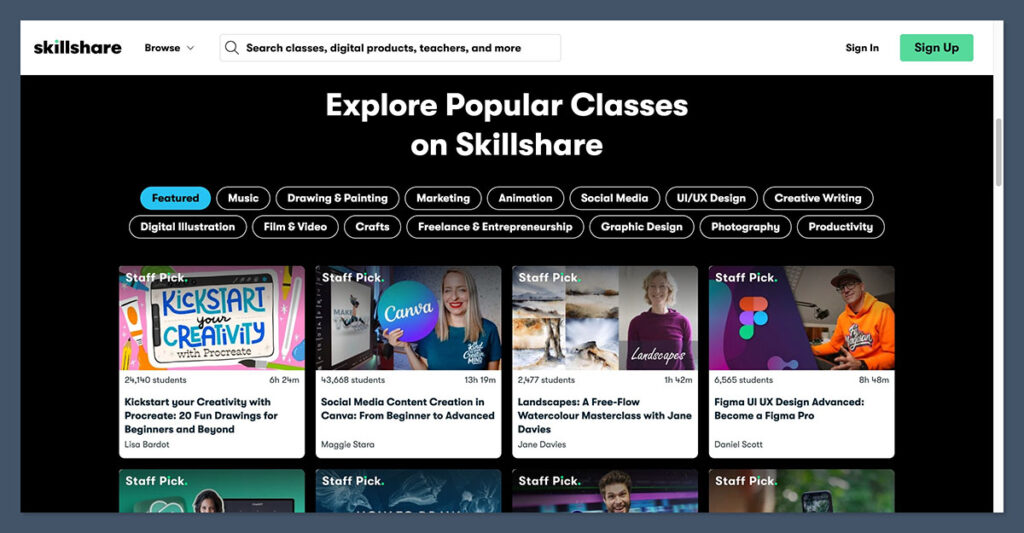
💰 Starting price: $13.99 per month (billed annually)🤖 AI features: AI content recommendations, personalized discovery, adaptive playlists
Skillshare is the platform I turn to when I want to learn something creative and hands-on. Its project-based approach – where every class includes a practical assignment – keeps the learning active rather than passive. Skillshare’s AI recommendation engine has gotten noticeably smarter, curating personalized playlists based on your interests, viewing history, and the types of projects you complete.
The platform excels in design, illustration, photography, and content creation, but it won’t help you earn formal credentials or tackle academic subjects.
✔️ Pros
- Project-based classes keep learning practical and engaging
- AI-curated playlists adapt to your interests and skill level
- Strong library for creative and practical skills
- Great discovery experience for curious, exploratory learners
❌ Cons
- No formal certificates or academic credentials
- No university partnerships
- Not suited for career-critical, technical upskilling
What’s new: Skillshare has enhanced its AI-driven discovery features, including smarter class recommendations and curated learning paths for creative disciplines. The platform has also introduced collaborative project features where learners can get peer feedback guided by AI prompts.
What I enjoyed about Skillshare’s AI is that it feels more like a creative discovery engine than a traditional tutor. After I watched a few classes on graphic design, the platform started surfacing related classes on typography, color theory, and brand identity – building out a natural learning progression I wouldn’t have mapped on my own.
The adaptive playlists are also a nice touch: they mix short and long-form classes based on how much time I typically spend on the platform.
How Much Does Skillshare Cost?
- Annual membership is $13.99/month (billed annually at $167.88)
- Monthly plan available at a higher price point
- 7-day free trial for new users
Bottom Line: Should You Use Skillshare?
Skillshare’s creative focus and AI-powered discovery make it the best platform for learners who want to explore creative skills through hands-on projects. If you’re looking for inspiration and practical skills rather than credentials, Skillshare delivers a learning experience that feels more like play than work.
Skillshare is suitable for:
- Creative learners interested in design, art, and content creation
- Curious explorers who want to try new skills
- Users who prefer project-based, hands-on learning
Skillshare isn’t suitable for:
- Users who need recognized certifications
- Learners focused on academic or highly technical subjects
- Career changers who need employer-valued credentials
#7. Mighty Networks: Best for Community-Driven AI Learning
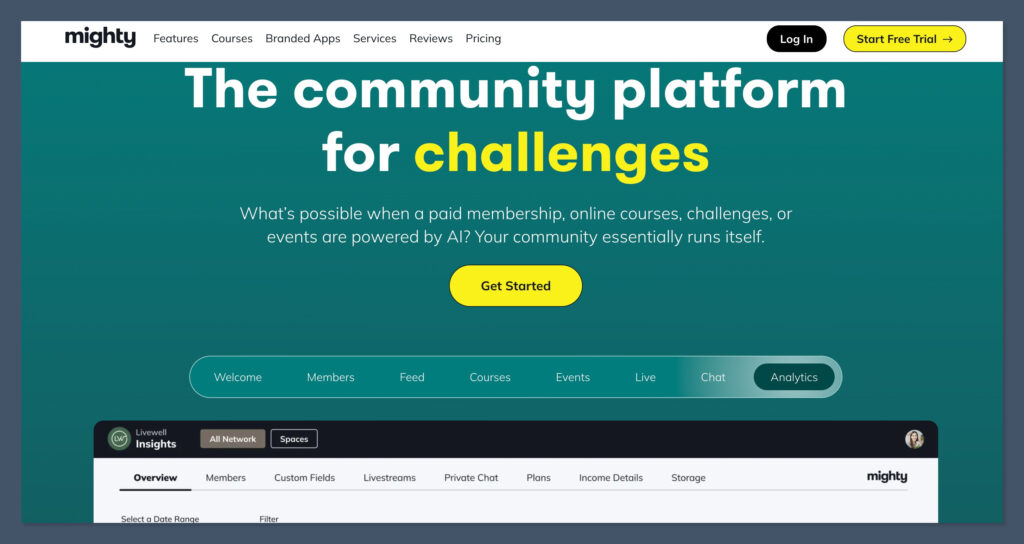
💰 Starting price: $41 per month
🤖 AI features: AI-powered community matching, adaptive content delivery, cohort intelligence
Mighty Networks takes a fundamentally different approach to online learning by putting community at the center of everything.
Rather than watching videos alone, you learn alongside a cohort of peers, with AI-powered features that match you with the right groups, surface relevant discussions, and adapt content delivery based on how the community engages.
If you’ve ever felt isolated learning online, Mighty Networks solves that problem. However, its course-building features are less specialized than dedicated learning platforms, and the quality of your experience depends heavily on the specific community you join.
✔️ Pros
- Community-first approach combats learning isolation
- AI matches you with relevant peers and discussion groups
- Strong for cohort-based, collaborative learning
- Great for memberships and ongoing peer support
❌ Cons
- Course-building tools less robust than dedicated LMS platforms
- Experience quality depends on the community you join
- Higher starting price than most consumer learning platforms
What’s new: Mighty Networks has expanded its AI capabilities with smarter community matching and automated content curation. The platform now uses AI to identify discussion patterns and surface the most valuable peer interactions, making cohort-based learning more effective.
What sets Mighty Networks apart is the social layer. When I joined a cohort-based writing course, the AI matched me with other learners at a similar level and surfaced discussions and feedback threads that were most relevant to where I was in the curriculum.
It felt more like being part of a study group than watching pre-recorded lectures. The peer accountability alone made me more likely to finish the course – something that’s a real problem with self-paced platforms.
How Much Does Mighty Networks Cost?
- Plans start at $41/month for community features with courses
- Business plan at $99/month adds advanced features and analytics
- 14-day free trial available to test the platform
Bottom Line: Should You Use Mighty Networks?
Mighty Networks is the best choice for learners who thrive on community interaction and peer support. Its AI-powered matching and cohort features create a learning experience that’s more engaging and accountable than studying alone. If you value human connection alongside AI-enhanced learning, this platform delivers both.
Mighty Networks is suitable for:
- Learners who want community and peer accountability
- Users interested in cohort-based, collaborative courses
- Creators and coaches who want to build learning communities
Mighty Networks isn’t suitable for:
- Self-paced learners who prefer to work independently
- Budget-conscious users who want free or cheap options
- Users who need formal academic credentials
How To Choose the Right Online Learning Platform
Whether you’re diving into online learning for the first time or switching platforms, you need to figure out what to look for. While I can help you compare platforms, you have to determine your priorities and must-haves, and identify what you can live without.
Below, I’ve put together a checklist of key factors to consider when researching or trialing a learning platform:
- AI and personalization: Does the platform use AI to adapt to your learning style? Can it assess your skill level and recommend the right courses? Does it offer an AI tutor or assistant?
- Content quality and depth: Are courses taught by credible instructors or backed by reputable institutions? Is the content regularly updated? Does it go deep enough for your goals?
- Credentials and career impact: Are the certificates recognized by employers? Can you stack credentials toward a degree? Do completions show up on your professional profile?
- Learning experience: Is the platform easy to navigate? Does it work well on mobile? Are there interactive elements, projects, or community features?
- Pricing and accessibility: Is there a free plan or trial? Is the subscription good value for what you get? Are there hidden costs for certificates or premium content?
- Community and support: Can you interact with other learners? Is there peer feedback or mentorship? Can you get help when you’re stuck?
- Flexibility: Can you learn at your own pace? Are there mobile apps for learning on the go? Can you download content for offline access?
How We Test Online Learning Platforms
This year, we evaluated over 40 online learning platforms through an in-depth testing process to determine our rankings and recommendations. Our research team spent over 150 hours analyzing each platform, covering six core categories of investigation.
We’ve focused on six core categories – each has been given a unique weighting to reflect what learners value the most:
AI and Personalization: 25%
We examine each platform’s AI tutoring capabilities, adaptive learning features, personalized recommendations, and how effectively the technology responds to individual learning needs.
Content Quality: 25%
We assess the depth, breadth, and credibility of available courses, including instructor qualifications, institutional partnerships, and how frequently content is updated.
Credential Value: 15%
We evaluate whether certificates and credentials are recognized by employers, whether they stack toward larger qualifications, and their real-world career impact.
User Experience: 15%
We test each platform ourselves to assess ease of use, mobile experience, interface design, and accessibility – this helps us speak from experience when recommending a platform.
Pricing and Value: 10%
We review pricing structures to determine what you get for the money you pay, including free options, trial periods, and overall value proposition.
Community and Support: 10%
We look at peer learning features, discussion forums, mentorship options, customer support quality, and the overall sense of community on each platform.
Final Verdict: Which Platform Do I Recommend?
Our research process has determined the top seven online learning platforms for AI-powered tutoring in 2026, and Coursera is the best platform for learners who want adaptive, personalized learning backed by world-class institutions.
It’s a real powerhouse, whether you’re looking to earn a degree, pivot careers, or upskill for your current role.
Each platform has its strengths – and weaknesses – so I know Coursera won’t be the right fit for everyone.
If you’re on a tight budget, Khan Academy’s Khanmigo AI tutor offers a remarkable free alternative.
For career-focused professionals, LinkedIn Learning‘s AI skill assessments and profile integration are hard to beat. And if you thrive on community, Mighty Networks brings the social element that most platforms lack.
If you’re unsure of where to start, I recommend taking advantage of the free plans, free trials, and audit options available on most of these platforms.
The best way to find your ideal learning platform is to experience it for yourself.