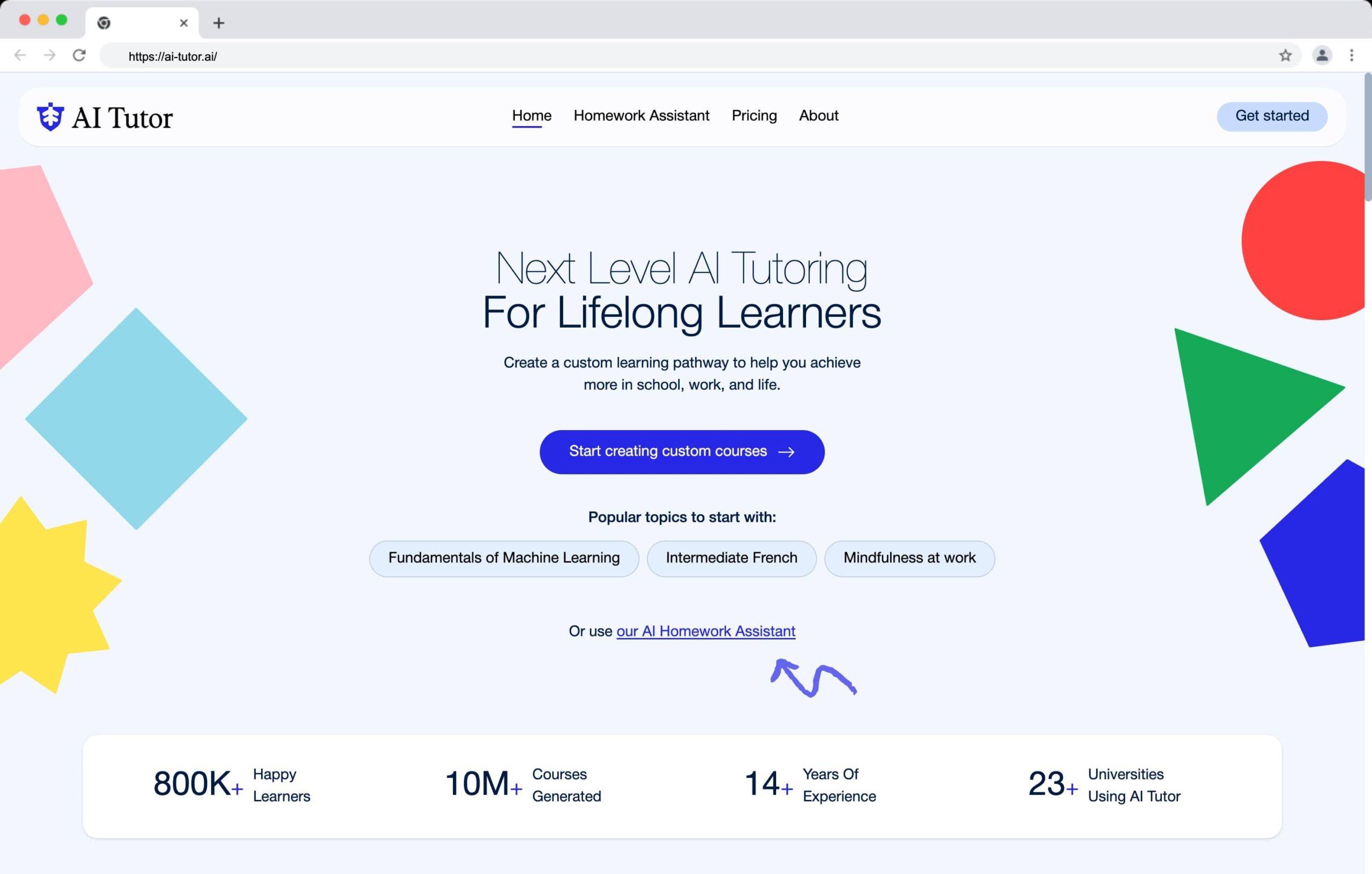
Artificial intelligence has made huge leaps in education, but one of the most common questions we hear is: can AI really do math? Whether you’re a student, parent, teacher, or just curious, the answer is yes — AI can solve math problems, and it can do so with impressive accuracy and speed.
But there’s more to it than a simple yes or no. AI doesn’t just spit out answers — advanced tools like AI-Tutor.ai break problems down step by step, help users understand concepts, and personalize learning based on skill level. So if you’re wondering how far AI can go with math, or whether it’s a good alternative to tutoring, let’s break it down in detail.
What Kind of Math Can AI Actually Solve?
AI is capable of solving a wide range of math problems — from basic arithmetic to advanced calculus. These systems don’t just work with numbers; they use algorithms and machine learning models to interpret, analyze, and solve problems across multiple fields of math.
Core Areas AI Can Handle
- Basic Arithmetic
AI can handle addition, subtraction, multiplication, and division instantly. Tools like AI-Tutor.ai are accurate down to the decimal and can provide explanations in plain English. - Algebra
From solving for x to simplifying expressions and handling inequalities, AI is especially strong in algebra. It can rearrange formulas, handle equations with multiple variables, and explain each manipulation. - Geometry
AI tools can assist with angles, area, volume, and coordinate geometry. By interpreting diagrams or user input, they calculate geometric values and explain why the answers make sense. - Trigonometry
AI can handle sine, cosine, tangent, and complex trigonometric identities. It can simplify expressions, solve for unknowns, and break down multi-step problems. - Calculus
This includes limits, derivatives, integrals, and even differential equations. Advanced AI math engines are trained on thousands of calculus problems and use symbolic reasoning to produce correct steps. - Statistics and Probability
AI understands statistical formulas, mean, median, standard deviation, and can walk through probability distributions and real-world data analysis. - Word Problems
This is where AI has improved the most. Using natural language processing, AI reads and interprets problems written in plain English and breaks them down logically.
Types of Math Problems AI Can Solve
| Math Area | Problem Types AI Can Solve |
|---|---|
| Arithmetic | Basic operations, decimals, percentages |
| Algebra | Equations, inequalities, functions, expressions |
| Geometry | Shapes, theorems, proofs, area/volume |
| Trigonometry | Identities, triangles, radians/degrees, graphs |
| Calculus | Limits, derivatives, integrals, optimization |
| Probability | Combinations, permutations, expected value |
| Statistics | Mean, median, mode, standard deviation |
| Word Problems | Multi-step logical reasoning, unit conversions, real-world math |
AI-Tutor.ai covers all these areas and uses a multi-modal approach, combining NLP (natural language processing), visual input, and symbolic reasoning to solve problems with context.
How Does AI Solve Math Problems?
AI solves math problems using a blend of machine learning, deep learning, and symbolic reasoning. These aren’t just hardcoded calculators. Tools like AI-Tutor.ai are trained on vast datasets of math problems and use multiple techniques to process and respond to input.
How It Works
- Step-by-Step Algorithms
Most AI math tools don’t just provide answers. They walk through each step, showing how the solution unfolds. This makes it easier to learn, not just cheat. - Natural Language Processing (NLP)
If you type a math problem in plain English — like “What is the derivative of x squared?” — NLP kicks in to interpret the question and convert it into mathematical language. - Image Recognition
Some AI tools (like AI-Tutor.ai) allow you to take a photo of a handwritten or printed problem. The AI uses computer vision to read the problem, interpret handwriting, and then solve it. - Symbolic Reasoning
Instead of brute-force calculations, symbolic reasoning allows AI to manipulate variables, identify patterns, and solve abstract math problems — similar to how a human would.
Common Input Methods for AI Math Solvers
- Text input (typing a question)
- Voice input (using voice-to-text for accessibility)
- Uploading an image of a math problem
- Selecting from menus for operations or problem types
Each method offers flexibility depending on the user’s age, ability, or device.
Is AI Better Than a Human Math Tutor?
This is the question on everyone’s mind. While AI can’t replace human connection, in many ways, it’s proving to be a more practical solution for most students — especially when it comes to cost, speed, and access.
Advantages of AI Math Tutors
- Available 24/7
AI never sleeps. Students can use it any time of day or night, which is especially helpful during homework hours. - Instant Feedback
AI provides real-time responses. No waiting for your next tutoring session or email reply. - Cost Savings
Most AI tools are free or very low-cost. While human tutors often charge $40 to $100+ per hour in the US, tools like AI-Tutor.ai are available for a fraction of the price or even for free. - Consistent Answers
AI never has a bad day, gets tired, or loses patience. It delivers the same quality every time.
Human vs AI: A Quick Comparison
| Feature | AI Math Tutor | Human Math Tutor |
|---|---|---|
| Availability | 24/7 | Limited by schedule |
| Cost | Free to low cost | $40–$100+ per hour |
| Patience | Unlimited | Can vary |
| Personal Connection | None | High |
| Flexibility | Very high | Medium |
| Speed of Response | Instant | Delayed (minutes to days) |
While a human tutor can offer emotional support, encouragement, and deeper mentorship, AI fills the gap for quick, accessible help — and works best when used alongside traditional support.
Real Results: Do Students Actually Learn with AI?
Many people worry that AI just gives answers, encouraging students to cheat. But the truth is, when designed well, AI tools teach — and they work. AI-Tutor.ai focuses on helping students understand the process, not just solve problems.
What the Data Shows
- In a 2023 EdTech study, students who used AI math tutors improved their test scores by an average of 27% over 8 weeks compared to those using textbooks alone.
- A report from the Journal of Educational Technology in early 2024 showed that students who practiced with AI tools spent 35% more time on homework and showed higher retention rates.
- AI-based tutoring tools like Khanmigo and AI-Tutor.ai saw sustained user engagement over 6 months, especially among students in underperforming schools.
Testimonials from Students and Parents
- “My daughter used to get frustrated with math. Now she asks AI-Tutor.ai before even calling me for help.” – Parent, New Jersey
- “AI-Tutor doesn’t just give me the answer — it explains why the answer is what it is.” – Student, Grade 10, California
- “Our school integrated AI-Tutor.ai into our curriculum, and we saw measurable improvements in just one term.” – Math Teacher, Chicago Public Schools
These testimonials reflect a broader trend: students prefer tools that offer instant, understandable feedback.
Where AI Still Falls Short
Even with all its benefits, AI is not perfect. There are some areas where human tutors still hold an advantage, especially when it comes to emotion, nuance, and certain edge cases.
Key Limitations
- Struggles with Handwriting
AI can misread poorly written problems, especially if numbers or symbols are unclear. - No Emotional Support
AI can’t encourage, empathize, or provide motivation the way a human tutor can. - Garbage In, Garbage Out
If you input a poorly phrased question or incomplete data, the AI can only work with what it’s given — and might return incorrect or confusing results. - Subject Gaps
While AI is strong in mainstream math topics, it may lack depth in highly advanced niche areas or cutting-edge university-level math.
That’s why many schools and parents use AI tools as supplements — not replacements — for human instruction. The goal is to give students a safety net and an extra source of support when they need it most.
The Future of AI and Math Education
AI is not replacing teachers. It’s becoming a tool that supports them. Over the next few years, AI-powered platforms will become more adaptive, more personalized, and more accessible.
What’s Coming Next
- Adaptive Difficulty
AI tools are learning to adjust to a student’s level, giving easier or harder problems depending on their performance. - Gamified Learning
Some platforms are already using badges, levels, and quizzes to keep students engaged. - Real-Time Progress Tracking
Students and teachers will soon have dashboards showing learning trends, struggles, and skill mastery in real time. - Multi-language Support
Tools like AI-Tutor.ai are expanding to offer support in Spanish, Mandarin, and other widely spoken languages.
The key takeaway? AI in education is still growing — and the tools are getting smarter, faster, and more helpful every year.
How AI-Tutor.ai Makes Math Easier
AI-Tutor.ai is designed to make math support accessible for everyone. Whether you’re a 5th grader, a college student, or a parent brushing up on algebra, the platform meets you where you are.
What Makes It Different
- Simple Interface
Type your question, take a photo, or speak — it’s that easy. No complicated steps. - Instant Explanations
Not just answers — every solution comes with a full explanation so students can learn along the way. - No Hidden Costs
Many features are free, and premium support starts under $10/month — far below the price of a private tutor. - Made for All Levels
Whether it’s fractions or calculus, AI-Tutor.ai adjusts its responses and tone based on the user’s level. - Safe and Private
No personal info required to use the platform, and no tracking of sensitive data.
Give It a Try
If you’ve ever been stuck on a math problem and didn’t know where to turn, AI-Tutor.ai is ready to help — instantly, affordably, and in plain English.
FAQs
Can AI solve my math homework?
Yes, AI can help you solve math problems, but good tools like AI-Tutor.ai will show the steps too, so you learn the concepts — not just get answers.
Is AI accurate with math?
When used correctly, AI is highly accurate. Mistakes typically happen when the input is unclear, handwritten, or misinterpreted. Always double-check answers for important assignments.
What’s the best AI math tutor?
AI-Tutor.ai is one of the best options available, offering accurate results, instant feedback, and explanations for a wide range of math levels.
Can AI understand word problems?
Yes. Thanks to NLP (natural language processing), AI can interpret most word problems — breaking them down into steps to solve logically.
Is AI tutoring safe for kids?
Platforms like AI-Tutor.ai are designed with safety in mind. No personal information is collected, and content is filtered to stay educational.