Why you can trust this comparison
Neutral and vendor-independent. I dug into how both tools actually behave, what each vendor claims versus delivers, the published research on false positives, and real cases where students were wrongly flagged. I sell neither tool and earn nothing from either choice.
If you are weighing GPTZero vs Turnitin, here is the honest headline before any marketing reaches you. GPTZero advertises 99.3% recall. Turnitin claims 98% accuracy with a false-positive rate under 1%. Yet on real student writing, independent testing puts both well below 80%, and the gap between those stories is where real students lose scholarships.
The short answer
- Most readers cannot actually choose Turnitin. It sells to institutions only, so for any individual the real choice is GPTZero (free tier, 10,000 words a month).
- Pick Turnitin only if your school already licenses it and you need plagiarism matching plus AI detection inside the LMS at scale.
- Neither result is proof. An AI detector score is a probability, not a verdict, and both tools false-flag ESL and non-native writers at alarming rates.
Want proof the stakes are real? In October 2023, University of North Georgia student Marley Stevens got a zero on a paper, fell below a 3.0 GPA, lost her HOPE Scholarship, and landed on academic probation. Her offense? Turnitin flagged her writing as AI-generated. She had used only the free version of Grammarly, which, in her words, “only ever” fixed “my punctuation and my spelling.”
Grammarly later confirmed those suggestions “are not powered by generative AI.” She was charged $105 for a misconduct seminar on top of the scholarship loss. That is the tension at the center of this comparison, and the frame to carry through every number below: detection is evidence at best, never proof of misconduct.
You are probably here for one of three reasons. You are an educator deciding what to deploy, a student checking your own work or worried about a false flag, or a content team vetting AI copy. I cover all three. Ahead: an at-a-glance table, six head-to-head criteria led by accuracy and false positives, then a best-for-use-case verdict with no single winner. Start with the snapshot.
GPTZero vs Turnitin at a Glance
Here is everything that matters in one table. If you read nothing else, read this and the Key Takeaways under it.
GPTZero is an AI-only detector that anyone can use. It launched in January 2023, just weeks after ChatGPT, and has grown quickly since. It has a free tier (10,000 words a month, no credit card), returns results in two to three seconds, highlights AI at the sentence level, supports around 10 languages, and ships a Chrome extension plus a keystroke-recording feature called Writing Replay.
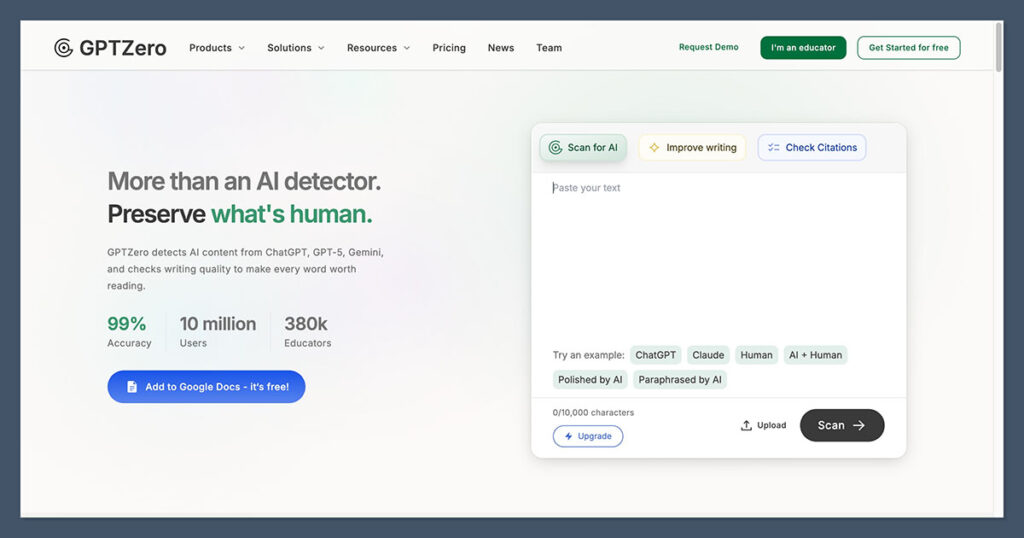
It sells to students, educators, and businesses alike, and reports 17 million users and 1 million educators across 3,500-plus colleges (all vendor-claimed figures).
Turnitin is something different. It is an institutional academic-integrity platform that bundles traditional plagiarism database matching with AI detection inside one LMS-integrated report. It does not sell to individuals at any price. Turnitin reports use across 16,000-plus institutions serving roughly 71 million students and says it has scanned 280 million-plus papers since launching AI detection in April 2023 (all vendor-claimed). Access runs exclusively through your school.

| Dimension | GPTZero | Turnitin |
|---|---|---|
| Tool type | AI-only detector | Plagiarism database + AI detection |
| Who can buy it | Anyone (free + paid) | Institutions only; individuals cannot buy |
| Vendor accuracy claim | 99.3% recall (tops Chicago Booth, controlled text) | 98% (vendor) |
| Independent / real-world accuracy | Falls well below 80% on real student writing | Falls well below 80% on real student writing |
| False-positive rate | Near-zero in controlled tests; much higher in the real world | Vendor <1% document-level; ~4% at sentence level (vendor-acknowledged) |
| ESL false positives | High (perplexity-based structural bias) | High; a Stanford study found 61.3% false positives on ESL essays |
| Speed | ~2-3 seconds | ~15-30 seconds (up to minutes) |
| Price / access | Free 10k words/mo; Premium ~$12.99/mo; Professional ~$24.99/mo | ~$2.59-$6.50 per student/year, institutional license only |
| Best for | Individuals, students self-checking, educators without Turnitin, content teams | Institutions needing plagiarism + AI + LMS at scale |
Key Takeaways
- Both vendors advertise near-perfect accuracy, but in independent testing real-world accuracy lands well below 80% on diverse text.
- Most readers cannot actually choose Turnitin. It is institutional-only, so for individuals the practical choice is GPTZero (or an alternative like Copyleaks or Originality.ai).
- Turnitin adds a plagiarism database and traditional source matching; GPTZero does AI detection only.
- Both disproportionately false-flag ESL and non-native English writers, a structural problem rooted in how perplexity-based detection works.
- GPTZero is faster, free to start, and self-serve; Turnitin is deeper, institutional, and built into the LMS grading workflow.
- Neither should ever be the sole basis for an academic-misconduct decision.
Those headlines hide a lot of nuance. The six criteria below unpack where each tool actually earns its claims, starting with the one everyone asks about first.
1. Accuracy and False Positives: Lab Claims vs Real-World Results
On controlled benchmarks GPTZero edges ahead, but in the real world neither clears the bar. The honest read: “accuracy” depends entirely on what kind of text you feed it, and there is no reliable winner here.
The vendor numbers look spotless. GPTZero advertises 99.3% recall and tops the independent Chicago Booth benchmark at around 99% accuracy on clean text. Turnitin markets 98% accuracy with a false-positive rate under 1%. The trouble starts the moment you leave curated samples. On real, messy student writing, accuracy on both tools drops well below 80%, and that is roughly where the gap between the marketing and the experience lives.
What matters more is that the headline number is not the one you actually get. Turnitin’s detector is deliberately tuned for caution: by the company’s own disclosure it catches only about 85% of AI writing, letting roughly 15% slip through on purpose to keep false positives under 1%. So the marketed 98% describes the calibration ceiling, not the everyday catch rate, and that tradeoff is baked into how the product works.
The false-positive side deserves the same honesty. Turnitin’s sub-1% claim is document-level; at the sentence level the company has acknowledged it runs closer to 4%, and in practice it climbs higher on some populations. GPTZero’s near-zero figure is a controlled-test number that loosens considerably on everyday writing. Neither tool’s clean lab score survives contact with a real classroom.
Hold onto one rule: a high AI score is a probability that text resembles AI patterns, not proof a human did or did not write it. Pair every accuracy figure with its false-positive caveat, always.
Winner: No clear winner. GPTZero wins controlled benchmarks, but for real student writing both are too unreliable to treat as proof.
2. The Fairness Problem: False Accusations and ESL Bias
The most important thing to know about both tools is not their accuracy ceiling. It is their false-positive floor. Both have demonstrably flagged innocent students, and both systematically disadvantage non-native English writers. There is no winner here, only a shared and serious liability.
This is the part the ranking pages bury. It belongs up front, because the cost is measured in scholarships and graduation dates.
Return to Marley Stevens. Flagged by Turnitin after using only free Grammarly, she received a zero, dropped below the 3.0 GPA her HOPE Scholarship required, was placed on academic probation into February 2025, and was charged $105 for a misconduct seminar. “AI detectors are garbage,” she said, “and there’s not much that we as students can do about it.” Her university later warned that grammar tools with AI features “can be flagged by Turnitin.” She raised more than $6,100 on GoFundMe; Grammarly donated $4,000 and hired her as a student ambassador.
Kelsey Auman’s case is more recent. At the University at Buffalo in May 2025, multiple Turnitin flags put her graduation at risk. She cleared the case using browser history and research documents, but called the outcome “damage control” rather than justice, and started a petition titled “Disable Turnitin AI Detection at UB.” “I was able to find a solid group of about 20% of our class that was flagged,” she said.
Then there is the structural problem, and it is the most important fairness fact in this whole comparison. A widely cited Stanford study ran seven AI detectors over TOEFL essays written by non-native English speakers and found an average false-positive rate of 61.3%, with nearly all the essays flagged by at least one detector. Native-speaker essays in the same test scored accurately, which isolates the bias cleanly: the detectors were not catching cheating, they were penalizing a writing style.
The root cause hits both tools. Perplexity-based detection reads limited vocabulary and predictable structure as “AI,” and those are exactly the traits of second-language and many neurodivergent writers (autism, ADHD, and dyslexia all raise the risk). Neither GPTZero nor Turnitin is exempt, because both lean on the same kind of statistical signal.
Institutions noticed. Vanderbilt was the first major school to disable Turnitin’s AI detector, in August 2023, after calculating roughly 750 false positives a year from 75,000 submissions and objecting that the tool gave no detail on how it reached its scores. Yale, Northwestern, Michigan State, and others have since disabled or rejected AI detection on similar grounds.
Winner: Neither. If your students include ESL or international writers, treat any flag from either tool as a starting question, never a verdict.
3. Plagiarism vs AI-Only: Scope and What You Actually Get
Different scopes make this one clear-cut. Choose Turnitin if you need plagiarism matching plus AI detection in a single report; choose GPTZero if AI detection, with authorship and citation extras, is all you need.
Plagiarism detection and AI detection sound like the same thing. They are not, and only one of these tools does both.
Turnitin runs a traditional similarity report, matching submissions against its database (280 million-plus papers, vendor-claimed) for copied sources, and layers AI writing detection on top in one institutional report. Of those scanned papers, Turnitin says 9.9 million were flagged as at least 80% AI. Since July 2024 it color-codes results: red for AI-generated, yellow for AI-paraphrased. An instructor opening a single report sees an overall similarity percentage with source links plus an AI percentage with highlighted sentences.
GPTZero does AI detection only. It has no traditional plagiarism database, so a clean GPTZero score tells you nothing about copied sources. What it adds instead is tooling Turnitin lacks: sentence-level AI highlighting, a Hallucination Detector that verifies citations, and Writing Replay for keystroke-level authorship proof. The product increasingly positions itself around authorship verification rather than detection alone. One tradeoff to know: reviewers note GPTZero tends to flag or clear a whole document rather than isolate AI paragraphs inside otherwise-human text, where Turnitin’s sentence-level model is more granular.
| What’s in the report | GPTZero | Turnitin |
|---|---|---|
| Traditional plagiarism (source matching) | No | Yes (280M+ papers, vendor-claimed) |
| AI-generated detection | Yes (sentence-level) | Yes (red highlight) |
| AI-paraphrase detection | Partial | Yes (yellow highlight, July 2024) |
| Citation / hallucination check | Yes | No |
| Authorship proof (keystroke) | Yes (Writing Replay) | No |
What each report literally shows you:
- GPTZero: a document-level AI probability, color-highlighted sentences, optional citation check, and an exportable writing-process record.
- Turnitin: an overall similarity percentage with source links, plus an AI percentage with highlighted sentences, all inside the LMS.
Winner: Turnitin for combined plagiarism and AI in one report; GPTZero for AI-only checks plus authorship and citation tooling.
4. Pricing and Access: Institutional License vs Free Tier
For almost everyone reading this as an individual, GPTZero wins by default. You cannot buy Turnitin at any price. For institutions, Turnitin’s per-student licensing is the real comparison.
You cannot buy Turnitin. Not for $10, not for $1,000. It does not sell to individuals at all. Its own help center confirms there is no individual or student subscription; access runs solely through your institution. The sister product iThenticate sells to individuals, but starts around $125 per document, so it is no shortcut for a student who just wants to self-check an essay.
Turnitin’s institutional pricing is opaque and quote-based, with no public list price. The figures that have surfaced through university contracts land roughly between $2.59 and $6.50 per student per year, depending on whether AI detection is bundled in. Treat that band as confirmed-but-variable. Either way, there is no free tier and no student pre-submission self-check.
GPTZero’s pricing is published (and vendor-stated, so verify before buying):
- Free: 10,000 words/month, no credit card required.
- Premium: ~$12.99/month, 300,000 words.
- Professional: ~$24.99/month, API access, batch scanning up to 250 files, LMS integration.
- Enterprise: ~$599.76/year for 2 seats (~$299.88/member/year).
- Educator/Classroom: custom per-seat quotes.
Note that GPTZero’s monthly rates run higher than its annual-billing rates. If you want a combined plagiarism-plus-AI tool you can actually buy as an individual, Copyleaks sells personal plans from around $9 a month, which is the gap GPTZero leaves open.
| Tool | Who can buy | Entry price |
|---|---|---|
| GPTZero | Anyone | Free (10k words/mo) |
| Turnitin | Institutions only | ~$2.59-$6.50/student/yr (institutional license) |
The access gap has a real consequence. A worried student can self-check on GPTZero for free, but has zero way to pre-check against Turnitin, and a low GPTZero score does not guarantee a low Turnitin score because the two use different models.
Winner: GPTZero for any individual, since it is the only one you can actually buy. Turnitin only if your institution already provides it.
5. Speed, Ease of Use, and Reporting Transparency
GPTZero wins on speed, accessibility, and transparency for the individual user. Turnitin wins on fitting an existing institutional grading workflow, but its scoring is more of a black box.
One tool returns a result in about three seconds from any browser. The other takes up to half a minute and only inside your LMS.
On speed, third-party reviews consistently clock GPTZero at two to three seconds and Turnitin at 15-30 seconds, sometimes minutes. On workflow, GPTZero lets you paste text at gptzero.me with no login for basic checks, run a Chrome extension, integrate with Google Docs, Canvas, and MS Word, batch up to 250 files, and hit an API with code in 17 languages across roughly 10 supported writing languages. Turnitin has no individual access at all: a student submits through the LMS, and the instructor sees a combined AI-plus-similarity report in workflow, with a 300-word minimum for a reliable score.
| Speed & usability | GPTZero | Turnitin |
|---|---|---|
| Result speed | ~2-3 seconds | ~15-30 seconds (up to minutes) |
| Access | Any browser, no login for basics | LMS only, institutional |
| Integrations | Chrome, Google Docs, Canvas, Word, API | LMS (Canvas, Blackboard, Moodle) |
| Report style | Document % + sentence highlights | AI % + similarity, segment-based |
| Min length | Short text accepted | 300 words for reliable score |
Transparency is where it gets interesting, and the tradeoff cuts both ways. GPTZero shows sentence-level color highlights and a document percentage, and explains its signals: perplexity and burstiness, with a perplexity score above 85 flagged as “more likely than not from a human source.” Turnitin scores text in roughly 250-word overlapping segments and deliberately hides low-confidence numbers, displaying scores of 1-19% only as “*%” and showing precise figures only at exactly 0% or 20% and above. That reduces false-accusation pressure from noisy low scores, but it also reduces auditability. As Emily Isaacs of Montclair State put it: “You can’t replicate or analyze the methodology the detection system used, so it’s a black box.” Her colleague Holly Hassel of Michigan Tech frames the educator’s bind plainly: “You imagine it as a tool that could be beneficial while recognizing it’s flawed and may penalize some students.”
GPTZero’s integration surface, for reference:
- Chrome extension for real-time checks
- Google Docs, Canvas, and MS Word plugins
- Batch upload up to 250 files (Professional)
- API in 17 programming languages
Winner: GPTZero for speed, access, and transparency; Turnitin for in-LMS institutional grading, if you accept its black-box scoring.
6. Edited AI and Real-World Robustness: Where Both Detectors Break
On lightly edited or paraphrased AI text, both tools’ accuracy collapses. This is a tie in the worst sense, and it is the clearest reason a score can never stand alone as proof.
This is where the marketing falls apart fastest. The moment AI text is paraphrased, reworded, or run through a “humanizer,” both tools’ accuracy drops sharply, and in independent testing detection can fall from the high tens to the teens with edits as simple as varying sentence length and swapping vocabulary. There is no single definitive number here, because it depends entirely on how heavily the text was changed, but the direction is consistent: a little editing goes a long way against either detector.
The reason is structural, not a tuning bug. Detection keys on statistical patterns (perplexity and burstiness) that editing disrupts, so it is a limitation of the whole approach. As one group of academics put it, you should assume a determined student can break any AI-detection tool regardless of how sophisticated it is. An entire category of bypass and “humanizer” tools exists precisely to exploit this, which is reason enough never to lean on a score as proof.
Both vendors are responding. Turnitin added AI-paraphrasing detection (yellow highlight, July 2024) and a model targeting AI-humanized text, though independent accuracy data for these is thin, so treat them as unproven. GPTZero leans on Writing Replay and authorship verification as its answer to the same problem.
Both vendors are responding. Turnitin added AI-paraphrasing detection (yellow highlight, July 2024) and a model targeting AI-humanized text (August 2025), though independent accuracy data for these is not yet available, so treat them as unproven. GPTZero leans on Writing Replay and authorship verification as its answer to the same problem.
Winner: Neither. Once AI text is edited, both tools are unreliable, which is exactly why no score should stand alone as evidence.
The Bottom Line: Which Should You Choose?
Skip to your role. There is no single winner here, because the right tool depends entirely on who you are and what you are allowed to access.
Educators and academic-integrity staff: If your institution licenses Turnitin and you need plagiarism, AI detection, and LMS integration at scale, use it, but as a conversation-starter and never a verdict. Understand the ESL bias, and look at how Vanderbilt and others responded before you rely on a score. Request prior work samples, ask the student to explain their argument, and escalate only when several evidence points converge. If you lack Turnitin, GPTZero’s batch upload (up to 250 files) and Canvas integration make a workable alternative.
Students: You cannot buy Turnitin, so GPTZero’s free tier (10,000 words a month) is the realistic pre-submission self-check. Carry one caveat: a low GPTZero score does not guarantee a low Turnitin score, because the models differ. Keep your drafts and version history, and use Writing Replay, as authorship proof. If you are ever flagged, a flag is not a finding, so request the full report and ask for a meeting before any formal step.
Content teams and business writers: GPTZero (API on Professional, plus the Chrome extension) is the tool for vetting freelance copy; Turnitin is not available to you at all. False-positive risk applies to marketing copy too, so keep humans in the loop and never reject a writer on a score alone. If you want something more content-tuned, Originality.ai is a purpose-built alternative worth a look, and Copyleaks adds a plagiarism layer.
Best for, at a glance:
- Educators with a license: Turnitin (as evidence, not proof).
- Educators without one: GPTZero (or Copyleaks).
- Students: GPTZero free tier, plus saved drafts.
- Content teams: GPTZero (or Originality.ai).
One principle binds all of it. Neither tool should be the sole basis for an accusation, both need human review, and both disproportionately false-flag ESL, non-native, and neurodivergent writers. Turnitin’s own guidance says its scores are “not sole evidence.” Detection is evidence at best. It is never proof.
Frequently Asked Questions
Is GPTZero or Turnitin more accurate?
There is no honest single answer. GPTZero wins controlled benchmarks (it advertises 99.3% recall and tops the Chicago Booth test) and Turnitin claims 98%, but on real student writing both fall well below 80%, and on ESL writing both fail badly. Treat any score as a probability, not proof.
Can a student buy Turnitin?
No. Turnitin sells institutional licenses only, with no individual or student subscriptions, so access comes solely through your school. Its sister product iThenticate sells to individuals starting around $125 per document. Any third-party site claiming to sell you a Turnitin license is a scam, not a shortcut.
Can these tools be wrong, and can I be falsely accused?
Yes, repeatedly and documented. Marley Stevens lost a scholarship, Kelsey Auman’s graduation was put at risk, and a Stanford study found a 61.3% false-positive rate on TOEFL essays across seven detectors. Turnitin’s own guidance calls its scores “not sole evidence.” False positives are real and hit ESL writers hardest.
Is GPTZero good enough to check my essay before submitting?
It is the most accessible option, free for 10,000 words a month, for a sanity check. But a low GPTZero score does not guarantee a low Turnitin score, because the two use different models. Use it to spot-check, keep your drafts and version history as authorship proof, and never assume the result grants immunity.
Do these tools detect ChatGPT and Claude?
Both are designed to, and GPTZero’s testing covers the current frontier models from OpenAI, Anthropic, and Google. But detection drops sharply once AI text is paraphrased or edited, so a “not detected” result is not a guarantee of human authorship either.
What should I do if I’m falsely flagged?
Do not panic; a flag is not a finding. Request the full report, gather evidence of your process (browser history, drafts, version history, notes), and ask for a meeting before any formal step. Use your right to due process. Many institutions, including Vanderbilt and the UB petition, agree a score alone cannot prove misconduct.