A survey of 1,185 Originality.ai users found that 72% switch tools within their first year. After testing the numbers myself, I can see why. Originality.ai catches only 31.7% of GPT-5 content in 2026, making it nearly blind to the most widely used AI model.
That does not mean Originality.ai is bad across the board. But if you need reliable detection of the latest AI models, FERPA compliance, or a lower false positive rate, the best originality alternatives will serve you better. Originality.ai’s Deep Scan still catches 100% of QuillBot-paraphrased AI content, and the all-in-one bundle (plagiarism, readability, SEO, fact-checking) is genuinely useful for content teams.
I tested and compared 8 alternatives using independent benchmark data (including the Chicago Booth study of 1,992 paired texts), real-world pricing, privacy certifications, API access, and segment fit. Every tool below includes a “Best for / Skip if” verdict so you can cut straight to the right pick.
False positive rates run 2-5x higher than claimed (4.79-5.7% in independent tests versus the marketed 0.5-1.5%). There is no FERPA compliance for educational institutions. Users are auto-opted into training data contribution without clear disclosure. At $14.95/mo with no free tier, the price stings when the results are unreliable.
One Trustpilot reviewer reported that Originality.ai adds 4+ extra hours per article due to false positives requiring rewrites. Another found that content written in 2016, years before ChatGPT existed, was flagged as fully AI-generated.
Quick picks:
- Best overall: GPTZero (99.5% accuracy, GPT-5 detection, free tier)
- Best for multilingual and code: Copyleaks (30+ languages, only code detector)
- Best free option: Scribbr (unlimited checks, no signup) or Grammarly (integrated workflow)
- Best API value: Winston AI ($0.07 per 1,000 words)
1. GPTZero: Best Overall Alternative for Accuracy and GPT-5 Detection
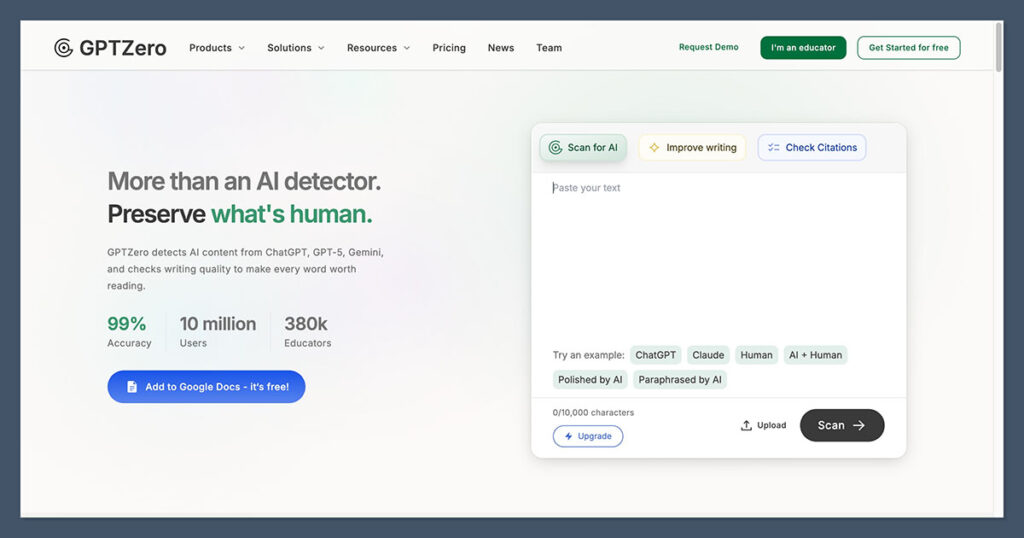
The Chicago Booth School of Business published the most rigorous independent AI detection benchmark in August 2025. GPTZero scored 99.5% accuracy with a 0.05% false positive rate across 1,992 paired human and AI texts. That is 95% fewer detection failures than Originality.ai on the same dataset.
The accuracy gap becomes even more stark on 2026’s most important model. GPTZero detects 100% of GPT-5 output and 94.9% of GPT-5-mini. Originality.ai manages only 31.7% on GPT-5 and a dismal 7.3% on GPT-5-mini. If you are evaluating best originality alternatives specifically because GPT-5 content is slipping through, GPTZero is the only serious option.
On privacy and compliance, GPTZero holds SOC2 Type-II certification, FERPA compliance, and GDPR compliance. It does not store documents submitted through its API. Originality.ai has none of these certifications and auto-opts users into training data contribution.
The feature set is solid for educators and teams. Sentence-level highlighting shows exactly which passages triggered detection. Writing Replay tracks authorship so students can demonstrate their writing process. LMS integrations cover Google Classroom, Moodle, and Canvas.
Pricing: Free tier (10,000 words/month), Essential $14.99/mo, Premium $23.99/mo, Professional $45.99/mo (500K words). API starts at $45/mo.
The weaknesses are real. GPTZero falls to roughly 18% detection after three passes through a humanizer tool. It struggles with texts under 200 words. Against QuillBot paraphrasing, it returns essentially coin-flip results (52% human, 42% AI on the same test where Originality.ai scored 100%).
It is also primarily English-focused.
| Feature | GPTZero | Originality.ai |
|---|---|---|
| Accuracy (Chicago Booth) | 99.5% | 85.0% |
| False positive rate | 0.05% | 0.11% |
| GPT-5 detection | 100% | 31.7% |
| FERPA compliant | Yes | No |
| Free tier | 10,000 words/mo | None |
| QuillBot detection | ~50% (coin flip) | 100% |
Best for: Education (FERPA), detecting GPT-5 and latest models, teams needing the lowest false positive rates.
Skip if: You need paraphrasing evasion detection or multilingual support beyond English.
2. Copyleaks: Best for Multilingual Teams and Code Detection
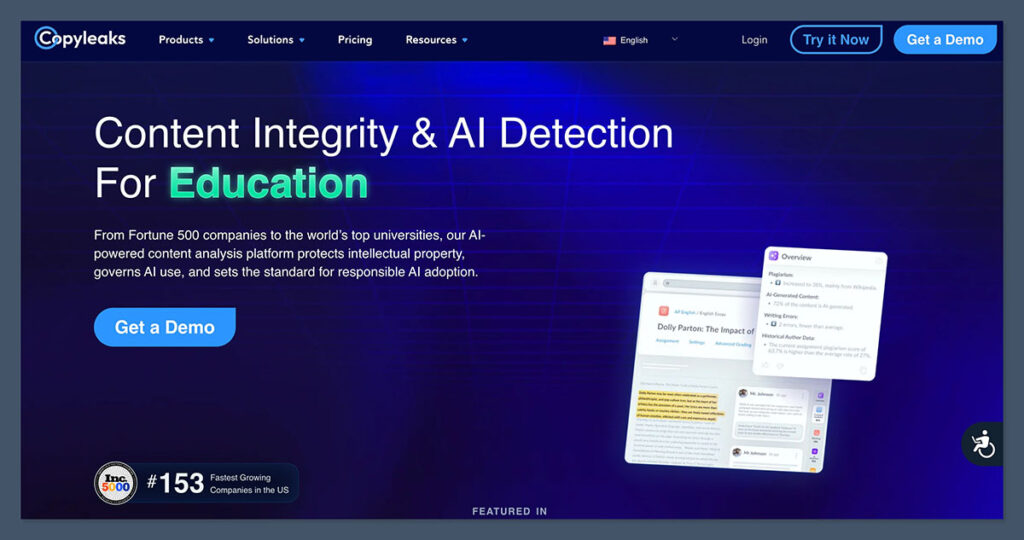
Copyleaks is the only major AI detector that can flag AI-generated source code. It also supports over 30 languages. If your team works in anything other than English prose, your shortlist just got very short.
The code detection capability has no equivalent in the market. GPTZero, Originality.ai, Winston AI, and every other detector on this list focus exclusively on natural language. For software documentation teams, CS education programs, and technical publishers reviewing code snippets, Copyleaks fills a gap that simply does not exist elsewhere.
On the multilingual front, Copyleaks handles Spanish, French, Arabic, Japanese, and 27+ additional languages. Axis Intelligence’s 2026 comparison ranked it the strongest multilingual detection option available. Originality.ai supports 15 languages by comparison.
Accuracy is respectable but not market-leading. In the 3,000-sample benchmark, Copyleaks achieved 90.7% overall accuracy versus GPTZero’s 99.3%. Bloomberg reported a 1-2% false positive rate. In a separate test of 126 documents, Copyleaks correctly identified every single one with zero errors.
The API ecosystem is developer-friendly. Copyleaks provides a RESTful API with SDKs for C#, Python, Node-JS, PHP, Ruby, and Java. API access is included in the $13.99/mo plan, compared to Originality.ai’s $179/mo Enterprise requirement.
For teams that need LMS integration alongside detection, Copyleaks serves as the backend engine for several learning management systems, making institutional deployment straightforward.
Pricing: AI detector $7.99/mo, Plagiarism $8.99/mo, Combined $13.99/mo (1,200 credits each). Free trial with 5 credits.
Copyleaks detected only 60% of paraphrased AI content. On Gemini 2.5-flash, it caught just 63.5% versus GPTZero’s 96.5%. Claude Sonnet 4 detection hit 74% compared to GPTZero’s 99%.
A larger benchmark found a 5.26% false positive rate. Reviewers also report it is relatively easy to bypass with humanizer tools.
Best for: Multilingual content teams, software and code detection, enterprises needing comprehensive API SDKs at affordable pricing.
Skip if: You need top-tier accuracy on English prose or detection of paraphrased and humanized content.
3. Winston AI: Best Budget API and Handwritten Document Scanning
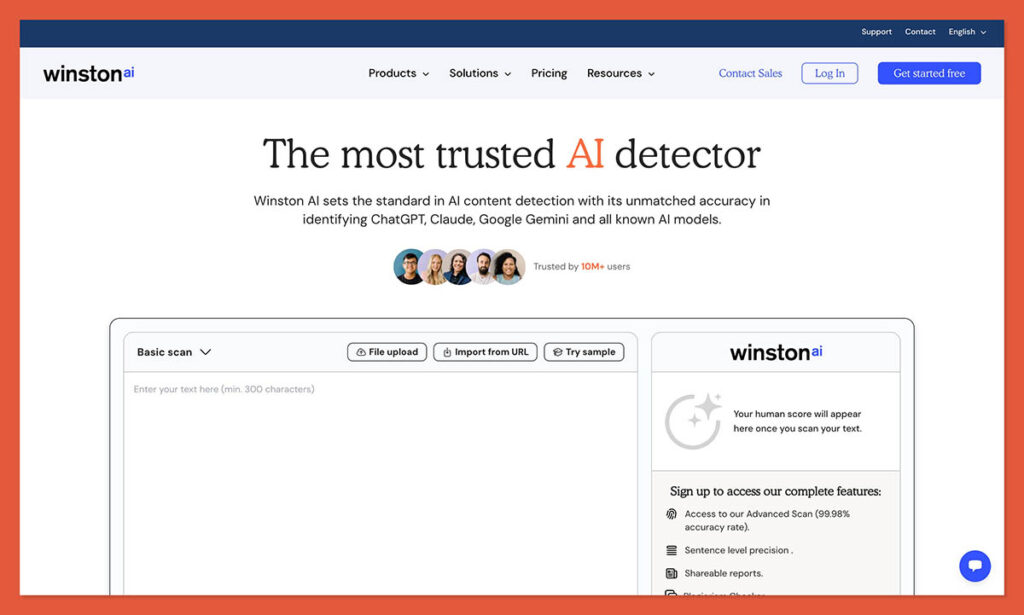
Winston AI’s API costs $0.07 per 1,000 words. That is over 90% cheaper than Originality.ai’s Enterprise API requirement ($179/mo) and significantly below GPTZero’s API entry point ($45/mo). For developers and small teams building detection into their workflows, the math speaks for itself.
The other standout feature is handwritten document scanning. Winston AI can process PNG and JPG images of handwritten documents and return a color-coded output map. No other major detector offers this. For educators receiving physical submissions or organizations digitizing handwritten content, it is a genuine differentiator.
The accuracy gap between claims and reality is significant. Winston AI advertises 99.98% accuracy, the highest claim in the industry. Independent testing shows real-world performance closer to 95-96%.
GrowthBrief’s testing found a 10% false positive rate on human-written samples. The tool also overestimates AI in structured content like numbered lists and formatted text.
Beyond the API, Winston AI includes sentence-level highlighting with color coding, PDF and Word document support, readability scoring, and a free tier for up to 2,000 words. The readability scoring is a useful bonus for content teams who want detection and quality feedback in one dashboard.
For developers, Winston AI provides a clean, separate environment with dedicated API keys. The documentation is straightforward, and the credit-based pricing model means you only pay for what you scan.
Pricing: Essential $12/mo (annual) or $18/mo (monthly). Growth $18/mo. API at $0.07/1,000 words (500,000 credits for $35).
Weaknesses: Self-published accuracy claims are not independently verified at the stated levels. No website-wide scanning. No Chrome extension. Oversensitive to formatted and structured text.
The verdict: Strong choice for developers who need the cheapest API and educators who receive handwritten work. Do not rely on the 99.98% accuracy claim at face value.
4. Grammarly AI Detector: Best Free Option With a Writing Workflow
If you already use Grammarly, you have a built-in AI detector you might not know about. The basic version is free, requires no signup, and Grammarly claims 99% accuracy with a top ranking on RAID’s independent benchmark.
The real value is integration. Instead of copying text into a separate tool, Grammarly’s AI detector works alongside grammar checking, spelling correction, and plagiarism scanning in one interface. The Authorship feature automatically categorizes text by origin: AI-generated, pulled from an online database, or typed by a human. Students can use this to demonstrate the originality of their own work before submission.
The paid Grammarly Pro plan ($12+/mo) unlocks phrase-level highlighting and more detailed analysis. The free version gives you a percentage score, which is enough for a first-pass screening. Grammarly detects ChatGPT, Gemini, Claude, and Microsoft Copilot output.
Pricing context: Free basic detection. Grammarly Pro $12+/mo for the full AI Detector agent. Originality.ai charges $14.95/mo with no free tier at all.
The reliability concerns are hard to ignore. Multiple reviewers documented that the same text produces “wildly different scores” on repeat scans. Grammarly itself warns that scores represent “an average estimate rather than a definitive percentage.”
There is also an ironic catch: extensive use of Grammarly’s own AI rewrite suggestions can trigger detection by Turnitin. One Grammarly feature can create problems that another Grammarly feature then flags.
The Chrome extension gives Grammarly broad platform coverage, convenient for writers working across Google Docs, email, and CMS editors. But this is a writing assistant that happens to include AI detection, not a purpose-built detector.
My recommendation: If you already pay for Grammarly Pro, use the built-in AI detector as your first-pass screening tool before investing in a dedicated detector. If you do not use Grammarly, this alone is not a reason to start.
5. Scribbr: Best Free AI Detector for Students (No Signup Required)
Scribbr lets you check 1,200 words for AI content, unlimited times, for free, without creating an account. For a student who needs to verify an essay before hitting submit, that is hard to beat on accessibility.
The zero-friction access is the main selling point. No email required, no credit card, no monthly cap on submissions. You paste your text, get a result, and move on. For longer documents, Scribbr offers a premium check at $19.95 per document (under 7,500 words) or $39.95 for documents over 50,000 words.
Scribbr already has strong name recognition in academic circles for citation generation and proofreading services. The AI detector extends that existing trust, which matters when a student is choosing between unfamiliar tools.
Scribbr hits only 80-84% accuracy in independent testing. On ChatGPT content specifically, accuracy drops below 80%. In one documented test, Scribbr flagged a passage from The Da Vinci Code, a bestselling novel published in 2003, as 100% AI-generated.
It also flagged a human-written blog introduction as 94% likely AI. These indicate a systemic false positive problem.
Weaknesses: The 1,200-word limit is restrictive for longer academic papers. A 5,000-word thesis chapter would require splitting into at least five separate checks, with no way to get a unified score. No API, no integrations, no bulk scanning, no sentence-level highlighting.
Quick comparison vs GPTZero free tier:
| Feature | Scribbr | GPTZero Free |
|---|---|---|
| Signup required | No | Yes |
| Check limit | Unlimited | 10,000 words/month |
| Per-check cap | 1,200 words | None |
| Accuracy | 80-84% | 99.5% |
For quick peace of mind, Scribbr. For actual reliability, GPTZero’s free tier wins every time.
6. Turnitin: The Institutional Standard You Cannot Buy Individually
Turnitin is the most recognized name in plagiarism detection, used by over 16,000 institutions worldwide. But you cannot buy it. There is no individual plan, no monthly subscription, no free trial for personal use.
If your university or publisher already uses Turnitin, its AI detection add-on is likely already scanning your submissions whether you know it or not. Understanding its capabilities helps you prepare.
Performance-wise, Turnitin holds up. In one test, it correctly identified all 126 documents with zero errors, a result matched only by Copyleaks. AI detection is an add-on to the existing plagiarism infrastructure, bundled with Originality (Turnitin’s own product), Gradescope, iThenticate, and Feedback Studio. LMS integration is standard at most universities.
Pricing reality: Institutional licensing runs $5,000–$20,000/year depending on size. The AI detection add-on costs approximately $0.41-$0.48 per student per year. Individual access is only available through iThenticate at $125 per manuscript (up to 25,000 words).
If your institution uses Turnitin and you want to pre-screen your own work, you cannot choose an “alternative” to Turnitin itself. What you can do is run your text through GPTZero or Grammarly’s free detector before submission. That gives you a heads-up before your professor sees the Turnitin report.
The verdict: Not an alternative you can switch to, but essential context for understanding the best originality alternatives landscape. If you need individual access to similar institutional-grade capability, GPTZero is the closest match.
7. Sapling AI Detector: Best Free API for Developers
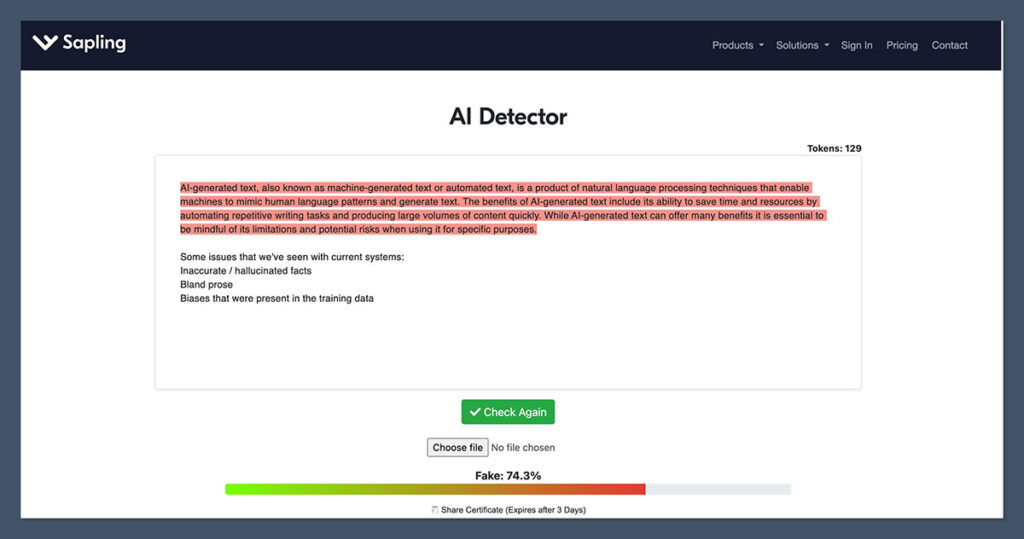
Sapling offers something no other tool on this list does: a free HTTP API with Python and JavaScript SDKs that handles detection across GPT, Gemini, Claude, Llama, and Mistral models. If you are building a prototype or testing a content moderation pipeline, you can start without spending anything.
The developer workflow is clean. Documentation is straightforward, integration is simple for automated screening workflows, and the multi-model coverage means you are not locked into detecting output from a single AI family. For CMS plugins, content moderation pipelines, and side projects, Sapling removes the budget barrier entirely.
Most free detection tools focus narrowly on ChatGPT output. Sapling covers GPT, Gemini, Claude, Llama, and Mistral in one API call. If you are building a tool that needs to screen content from multiple AI sources, this breadth matters.
Pricing context: Winston AI’s API starts at $0.07 per 1,000 words ($35 for 500K credits). Copyleaks API runs $13.99/mo. GPTZero API begins at $45/mo. Originality.ai API requires the $179/mo Enterprise plan.
Sapling is free.
The tradeoffs are predictable. There is limited independent benchmark data for Sapling compared to GPTZero or Copyleaks. It is not designed for high-volume production use. The brand is less established, and accuracy claims are harder to verify against rigorous third-party tests.
Weaknesses: No large-scale independent accuracy benchmarks available. Not built for production-grade volume. Smaller user community and less market validation.
My recommendation: If you are building a prototype or need a free detection API to test with, start with Sapling. Once you need production-grade accuracy and volume, graduate to Copyleaks ($13.99/mo with 7 SDKs) or GPTZero API ($45/mo for the best accuracy).
8. ZeroGPT: Free Unlimited Scans With a Major Accuracy Problem
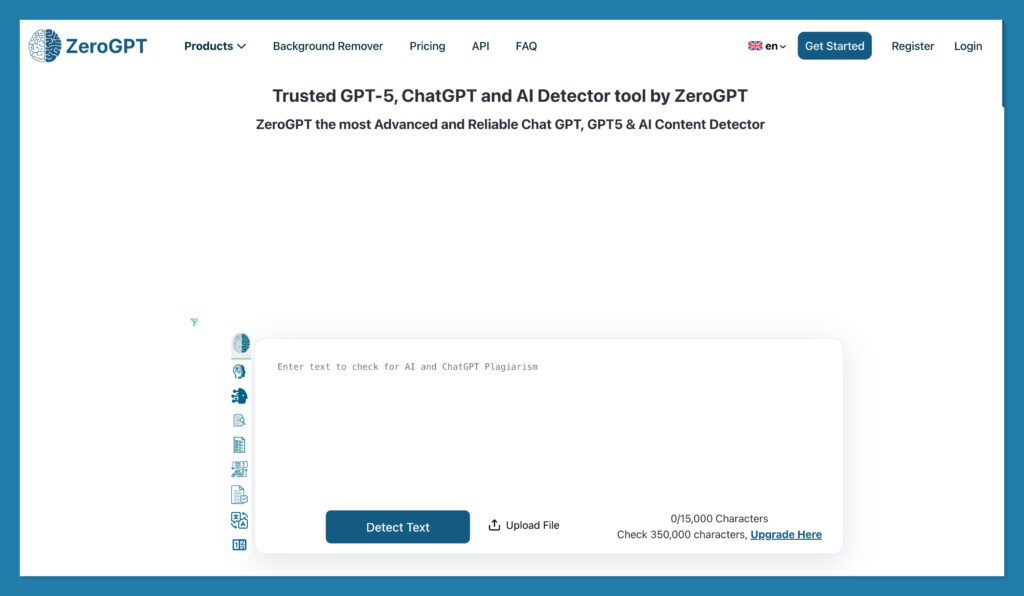
ZeroGPT offers something appealing on the surface: unlimited free AI detection with no account required. The catch is a false positive rate between 20-26%, meaning it flags roughly 1 in 4 human-written texts as AI-generated.
The accessibility explains its popularity. No signup, no word limits, no monthly caps. Paste text and get an instant result. Two of the three competitor articles I reviewed include ZeroGPT on their lists.
Traffic follows accessibility. But accessibility without accuracy creates more problems than it solves.
To put the false positive rate in perspective: if you scan 10 human-written articles through ZeroGPT, 2 to 3 will be incorrectly flagged as AI. GPTZero’s false positive rate is 0.05%. That means ZeroGPT is roughly 400 to 500 times more likely to wrongly accuse a human writer.
Using ZeroGPT results to accuse a writer or student of AI use is indefensible given the documented error rate. Non-native English speakers face even higher risk, since simpler vocabulary patterns are more likely to trigger false positives. There is no transparency on the detection methodology, no API, no integrations, and no sentence-level analysis.
My own testing confirmed the inconsistency. The results were unreliable enough that I would not trust ZeroGPT for any decision with real consequences. When free tools like GPTZero (10,000 words/month) and Scribbr exist with far better accuracy, there is no practical reason to accept ZeroGPT’s tradeoffs.
Weaknesses: Severe false positive rate. Opaque detection methodology. No API. No integrations. No granular analysis.
Best for: Curiosity checks where the result does not matter.
Skip if: You need to make any decision based on the result. Use GPTZero’s free tier or Scribbr instead.
9. How to Pick the Right Originality.ai Alternative for Your Situation
After eight tool reviews, the right alternative depends entirely on what you are using it for. Here is the shortest path to your answer.
Educators (K-12 and university): GPTZero. FERPA compliant, SOC2 certified, LMS integrations for Google Classroom, Moodle, and Canvas. Lowest false positive rate means fewer wrongful accusations.
Content agencies and SEO teams: GPTZero for raw accuracy, or stick with Originality.ai if paraphrasing evasion detection (Deep Scan) matters most to your workflow. Winston AI at $12/mo is the budget alternative with readability scoring included.
Students checking their own work: Scribbr (free, no signup) for a quick check. GPTZero free tier (10,000 words/mo) for reliable results. Never rely on a single tool if the stakes are high.
Multilingual or global teams: Copyleaks. It is the only serious option for 30+ languages and the only detector that catches AI-generated code.
Developers building detection features: Start with Sapling (free API). Scale to Winston AI API ($0.07/1K words) or Copyleaks API ($13.99/mo with 7 SDKs) for production.
Budget-conscious individuals: Grammarly (free if you already use it), then Scribbr (free, no signup), then GPTZero free tier (10,000 words/mo).
Cross-cutting advice:
- Always use 2+ tools for high-stakes decisions. No single detector is definitive.
- All detectors struggle with texts under 200 words. Submit longer passages when possible.
- Non-native English writers should prefer Copyleaks or cross-check with multiple tools to reduce false positive risk.
- No tool reliably detects content after 3+ humanization passes.
Privacy note: If data handling matters, GPTZero (SOC2/FERPA/GDPR) is the safest choice. Originality.ai auto-opts you into training data.
Pricing comparison at a glance:
| Tool | Starting Price | Free Tier | API Access |
|---|---|---|---|
| GPTZero | $14.99/mo | 10,000 words/mo | From $45/mo |
| Copyleaks | $7.99/mo | 5 trial credits | Included at $13.99/mo |
| Winston AI | $12/mo (annual) | 2,000 words | $0.07/1K words |
| Grammarly | $12/mo (Pro) | Basic score free | No |
| Scribbr | $19.95/doc | 1,200 words/check | No |
| Sapling | Free | Yes (full API) | Free |
| ZeroGPT | Free | Unlimited | No |
| Originality.ai | $14.95/mo | None | $179/mo (Enterprise) |
FAQ
Is Originality.ai still worth it in 2026?
It depends on your use case. Originality.ai leads in paraphrasing evasion detection (100% on QuillBot) and bundles AI detection, plagiarism checking, readability scoring, and SEO tools into one subscription. But it catches only 31.7% of GPT-5 content, has no FERPA compliance, and auto-opts users into training data.
A survey found 72% of users switch within a year. For education or GPT-5 detection, it is not worth it. Content agencies focused on catching paraphrased AI submissions may still find value in the Deep Scan feature.
Which AI detector has the lowest false positive rate?
GPTZero at 0.05%, based on the Chicago Booth study (August 2025, 1,992 paired texts). Copyleaks is second at 1-2% per Bloomberg reporting. Originality.ai’s real-world false positive rate is 4.79-5.7%, roughly 2-5x higher than its claimed 0.5-1.5%. ZeroGPT’s rate sits between 20-26%.
A low false positive rate matters because every incorrect flag can lead to wrongful accusations, stressful appeals processes, and wasted time on rewrites.
Can AI detectors catch GPT-5 and Claude 4 content?
GPTZero detects 100% of GPT-5 output and 99% of Claude Sonnet 4. Originality.ai catches only 31.7% of GPT-5 and 7.3% of GPT-5-mini. Copyleaks manages 74% on Claude Sonnet 4 and 63.5% on Gemini 2.5-flash.
No tool catches everything after humanization passes. If detecting the latest models is your priority, GPTZero is currently the only reliable option.
Do AI detectors store my text or use it for training?
GPTZero does not store documents on API submissions and holds SOC2, FERPA, and GDPR certifications. Originality.ai auto-opts users into data contribution for model training without prominent disclosure. Winston AI and Copyleaks state they do not save or share submitted text.
Always check the privacy policy before uploading confidential, proprietary, or client content. This is especially important for EU-based teams where GDPR data residency rules apply.
What is the best free Originality.ai alternative?
Scribbr offers unlimited free checks at 1,200 words per submission with no signup. Grammarly provides a free AI percentage score without an account. GPTZero gives 10,000 free words per month (account required).
For accuracy, GPTZero’s free tier is the strongest option at 99.5% accuracy versus Scribbr’s 80-84%. For zero friction when you just need a quick check, Scribbr wins.
Why do AI detectors flag my human-written content as AI?
Concise phrasing, repetitive sentence structures, formal tone, and short texts under 200 words all trigger false positives. Non-native English speakers are disproportionately affected because simpler vocabulary patterns register as AI-like to detection algorithms.
Independent testing shows an average 10% false positive rate on technical or non-native English writing. Even punctuation changes alone can alter Originality.ai scores. Using 2+ tools and submitting longer passages reduces your risk significantly.