I think we’ve all gotten very good at convincing ourselves that we’re absolutely incredible at spotting signs of AI in content, probably because, in fairness, AI influence used to be pretty obvious. You’d see a generic GPTism or an em dash, feel your internal alarm go off, paste the content into any random AI detector, and get a score that immediately confirmed your suspicion.
Unfortunately, that’s created a very dangerous scenario in the education space. Instead of assuming a student has learned some new words or improved their writing, we surmise that any change in a student’s work must be a result of AI, and since most AI detectors struggle with very high false positive rates (particularly with structured academic writing), their scores don’t always help much.
I do think it’s important for teachers to check for AI, since your students probably aren’t learning much if they really are passing all of their homework onto an LLM. I just also think that we need to be more cautious about inspecting the work produced.
Signs of AI-Generated Writing: What to Look For
Most of us have seen enough AI-generated content to recognize the ‘common’ signs, at this point, though I would say that plenty of LLMs use phrasing and words that make perfect sense for a human to use too, so I wouldn’t assume that a student using the word “delve” or “moreover” automatically means a paper was written by ChatGPT.
Look for bigger signs such as:
The Writing Doesn’t Sound Anything Like the Student
Again, students learn and expand their vocabulary over time, so them deciding to use a couple of unfamiliar words here and there really isn’t evidence of anything. Pay more attention to a huge and reasonably sudden change in how their writing sounds.
If they’ve always written in a pretty straightforward way, with lots of contractions, informalities, and shorter sentences, and then they suddenly hand in an essay filled with jargon and formal prose, that might signal an issue.
The good thing about looking at the overall style of writing here is that you, as a teacher, have an advantage over AI detectors. You know what your students have been learning in class, and what they usually sound like, and you know what you asked for in assignments. Maybe you told a student to try using longer sentences, or reduce slang. You can take that into account.
Generic Arguments and Fake Citations
We’re all familiar with how AI tends to create an illusion of ‘depth’ in an argument, saying something’s not just [one thing] it’s [something else], without actually explaining the connection or why that statement matters.
If you’ve asked your student to write a persuasive essay about something like why smartphones shouldn’t be banned from schools, look at how they frame the argument. Do they just list statistics and studies, or do they explain what they think they imply? Do they bring in any of their own personal experiences or opinions?
Another thing to check for is fake citations and factual errors in the evidence your student decides to use. LLMs are brilliant at inventing academic articles, attributing quotes to the wrong people, or making up ‘results’ from a study that never really happened. Look at the study from May 2026 where researchers looked at 456 AI-generated citations and found nearly half of them had something fabricated in them. You should be able to check if the references are accurate.
A generic argument might just mean the student still doesn’t understand the topic very well and a bad citation could be a mistake, but even if that’s the case, a conversation with them will give you an idea of what you need to work on.
The Structure Is Very Predictable
Once again, don’t rely on this too much by itself, because there’s every chance you’ve taught your students to follow specific formulas when they’re writing certain kinds of papers. It makes plenty of sense for an essay to introduce a problem, discuss the importance of it, cover different perspectives, and then wrap up with a verdict.
It’s a little more worrying if everything seems formulaic, as though your student has been following a checklist for every paragraph. Same thing if every single sentence or paragraph is almost exactly the same length, and the writing is packed with predictable transitions and summaries.
I know some people talk about checking for things like ‘perplexity’ and ‘burstiness’ too, which measure how predictable and varied the writing is. Perplexity-based methods were common in the early days of AI detection, but they aren’t how every detector works. Pangram, for instance, uses a classifier model trained to distinguish human writing from AI-generated text, rather than relying on perplexity. Either way, just because an essay is hyper-neat doesn’t mean a human didn’t write it.
What to Look For Outside of the Writing
I personally think this part is a lot more telling than checking the writing for specific words or grammatical elements, but it still deserves a fair bit of caution. For instance, I might write a whole article in a Word document and then paste it into a different system, so just checking for ‘pasted blocks’ doesn’t tell anyone I’ve definitely been using an LLM.
Evidence of Time Spent on an Essay
Google Docs and a handful of other tools come with version histories, so you can look back and see how the piece might have come together over time.
If a student submits an assignment, you check the version history, and it seems like the whole thing appeared out of nowhere, that could be a sign you have something to talk about. Just remember that students can write in other apps, work offline, and paste completed work (without the planning history) into a submission tool.
If a piece does seem to come out of nowhere, ask the student a little about their writing process, what they researched, and if they had any particular difficulties with certain sections before you accuse them of using AI.
Sudden Jumps in Quality
This is similar to checking for the use of new words and phrases in a piece of content, so it needs the same care. A student using better evidence in an essay or updating their grammar doesn’t automatically mean they’re relying on AI. They could be getting better at their work.
Look at their behavior in class first. Do they seem like they’ve understood any feedback you’ve been giving, or that they’re confident with the assignment? If they’ve given a very good argument, can they explain the thinking behind it? Maybe they could tell you why they chose one quote over another, or tell you why they’ve made an unusual statement.
Remember, some students will still struggle to give a good answer on the spot, even if they genuinely did the work and the research themselves. Give them a chance to refer to their notes if they need to, or come back to you and explain their thinking in writing.
Scores from a Reliable AI Detector
Be very careful with this one, because as I said before, no AI detector is perfect. If you’re going to approach a student and question whether they’ve used AI, you need more than a percentage score.
I recommend using Pangram for educators, for a few reasons. First, it integrates with Canvas, Google Classroom, Moodle, Brightspace, Schoology, and Blackboard, as well as Google Docs, so it fits into tools and platforms teachers already use. Secondly, it’s got the lowest false-positive rate of any detector I’ve seen. Thirdly, it sorts content into more groups than just “AI-generated” or “human-written”.
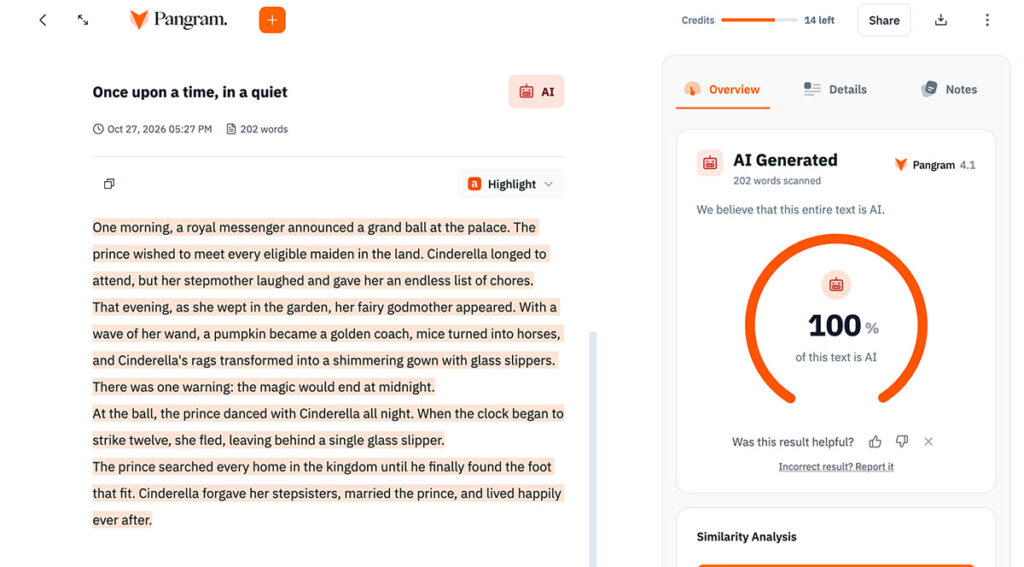
Pangram can tell if writing has been AI-assisted, which may just mean a student used a tool for research, or something like Grammarly to spruce things up before submission. It can also identify hybrid writing (where a bot and a human author work together), and tell you if sections look like they’ve been humanized by an outside tool. All of that information gives you a better idea of what you really need to address with a student, before you start accusing them of anything. You can read more about how it performed in my Pangram review.
If you want to see how the alternatives compare, I’ve also tested Turnitin and the Grammarly AI Detector on real student essays, and my roundup of the best AI detectors for teachers ranks the main options side by side.
Use what you learn from something like Pangram as evidence to back up why you’re concerned, but always give the student a chance to explain what really happened.
What to Do If You Suspect a Paper Is AI-Generated
I know teachers are busy, and it’s easy to spot something in a paper that seems AI-generated, feel frustrated at a student’s apparent lack of effort, and immediately bump down their grade. Still, the best thing you can do is slow down and look at all the facts side by side.
Compare the Paper with Previous Assignments
First, look at the paper next to a few relatively recent ones from the same student. Are there any sudden and dramatic differences? A few new words or a bit of improvement in structure or research doesn’t prove anything, but if you can’t see any evidence of that student’s work evolving over time, and it suddenly seems to change for just one essay, that may be something to talk about.
Check the Sources and History
Look up any questionable references or citations, and make a note of anything that might not be completely accurate. If there’s a version history attached to the document your student submitted, you can check that too. Just don’t assume pasted blocks were automatically pasted straight from a GPT.
Use a Trustworthy AI Detector
Now you can use something like Pangram to examine any passages you’re feeling particularly uncertain about. Note down whether they’re flagged as fully AI-generated, AI-assisted, paraphrased, or hybrid, and what each of those things could mean. Make a note of anything flagged that you’ve missed too, even sections identified as “human-written” that you assumed were produced by AI.
Speak to the Student
Bring all of the evidence you’ve gathered to the conversation, and ask your student to talk you through how they approached the assignment first. Be calm, and avoid making any direct accusations straight away, otherwise they’re likely to get defensive. Then ask questions about the things you’ve spotted, and give them a chance to explain why the style, research process, or grammar looks different.
Follow Your School’s Academic Integrity Policy
Check what AI assistance was permitted by the assignment. For instance, the student might have been allowed to use a tool for research or spelling checks. It’s also worth making sure you’re following any rules your institution has set for using AI detection tools too, particularly if you’re not sure how submissions are stored and used by the detector. Then document your findings, and let the student respond according to the policies you have in place.
Be Cautious When Checking for AI in Student Papers
Teachers definitely need to be wary of evidence that students are overly reliant on AI these days, particularly since these tools are making it so easy to speed up a lot of time-consuming homework. Still, I think we need to be careful of convincing ourselves that we can definitely judge whether AI was involved in a piece of work just with a gut call, or an AI detector score, even if that score comes from something as reliable as Pangram.
As a teacher, you should have more evidence to work from. You know how your student usually writes, what they’ve struggled with before, and where they’re improving, and that can help you make a more honest assessment of how much bot assistance they might have got.
If you do think that there’s a problem, don’t rush into accusations, gather the evidence you have, take the time to speak with the student, and give them a chance to explain anything you’re concerned about. Improvement from one assignment to the next shouldn’t be automatic evidence that your students are cheating. It could be a sign that they’re doing what they’re supposed to do: learning how to get better.